Understanding the K League’s 2026 Foreign Player Overhaul: What the Quota Abolition Means for How Squads Are Built

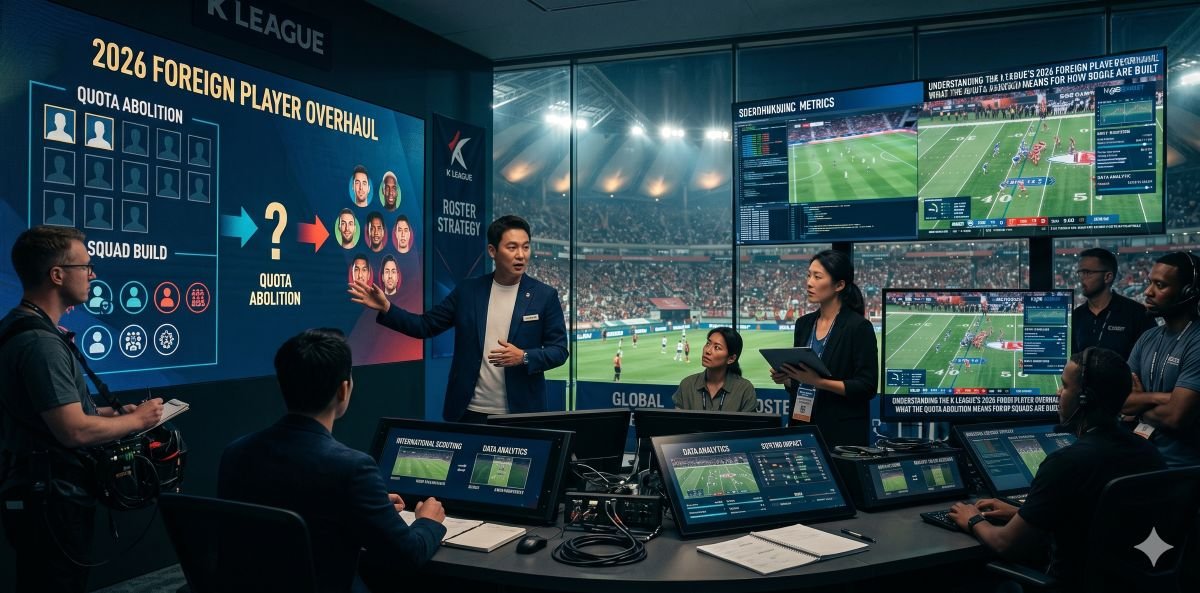
For the first time in the 43-year history of Korean professional football, K League clubs can sign as many foreign players as they choose. The 2026 season marks a structural reset in how squads are assembled — one that arrives simultaneously with a league expansion on the horizon and a set of additional rule changes affecting goalkeeper eligibility, youth requirements, and the definition of who counts as a domestic player. Understanding what changed, what stayed the same, and why it matters gives any Korean football fan a clearer framework for following the 2026 season.

What the Quota Abolition Actually Means

The registration limit that previously capped the number of foreign players a club could hold on its books no longer exists. In K League 1, that cap was six players as of the 2025 season. In K League 2, it was five. Both are gone.

What remains is a deployment cap. A maximum of five foreign players may be on the pitch simultaneously in K League 1, or included in the matchday squad. This is itself an increase — the previous on-pitch limit was four. K League 2 retains a four-player simultaneous limit, but also removes the registration cap and now allows a 20-player matchday squad, up from 18.

The practical consequence is that clubs can now build foreign player depth beyond what they could previously deploy. A club could register eight or ten foreign players and rotate them across competitions and fixtures without breaching any rule, as long as no more than five are on the pitch at once. Early-season data reflects how quickly this has been absorbed: by late March 2026, K League 1 clubs had registered 57 foreign players across 12 clubs, drawn from over 20 countries, with Brazil accounting for 24 of them.

According to K League United’s coverage of the rule change announcement, the federation’s stated rationale was international competitiveness. The AFC Champions League had already scrapped its own foreign player quota, meaning Korean clubs were operating under domestic restrictions that their continental rivals were not. The abolition brings K League 1 into alignment with the broader regional trend.

The 26-Year Goalkeeper Ban Is Lifted

Running alongside the quota abolition is a change that carries significant symbolic weight: the ban on foreign goalkeepers, in place since 1999, has been removed.

The ban’s origin was practical. In the mid-1990s, when the K League operated with only eight clubs, foreign goalkeepers — most notably the Soviet-era players who dominated the position at their clubs — were considered to be preventing the development of Korean domestic goalkeepers. The restriction was introduced to protect a position that feeds directly into the national team pipeline.

The K League board’s decision to lift it in 2025, effective for the 2026 season, rested on changed circumstances. With 26 professional clubs now spread across K League 1 and K League 2, the argument that there are insufficient playing opportunities for Korean goalkeepers no longer holds in the same way. The board also noted that the salary market for domestic goalkeepers had become disproportionately inflated — an artificial effect of a protected market with constrained supply.

What “Homegrown” Means Under the Current Rules

The removal of foreign registration limits does not mean every foreign-born player in a club’s squad counts toward the five-player on-pitch cap. The K League’s homegrown system — introduced in 2025 and carried forward into 2026 — creates a domestic classification pathway for foreign-nationality players who developed through Korean football’s amateur structure.

A player of foreign nationality who spent three consecutive years, or five cumulative years, in Korean amateur clubs qualifies as a domestic player upon signing professionally. This classification is meaningful: such a player does not count against the five-player simultaneous limit when on the pitch.

North Korean players are also treated as domestic players under South Korean nationality law, a provision that has existed for some time but carries greater practical relevance now that the foreign player classification directly determines deployment constraints.

The U22 Rule That Survived in a Different Form

The mandatory U22 starting rule — which required clubs to name an under-22 player in the starting lineup and on the bench to access all five substitution slots — has been dropped for K League 1. The rule had been widely criticized as a mechanism that clubs gamed rather than genuinely applied, often fulfilling the letter of the requirement through early substitutions.

What replaced it is less coercive but still present: the 20-man matchday squad must include at least two players under 22. A squad with only one U22 player is reduced to 19. A squad with none is limited to 18. The intent shifts from forcing coaches to make tactical choices around young players to simply ensuring young players remain part of the squad environment.

What This Means for Seongnam and K League 2 Clubs

Seongnam FC remains in K League 2 following relegation from the top flight in 2022. As explored in how Seongnam FC’s promotion pathway works under the 2026 K League 2 structure, the club operates under the K League 2 framework, which retains a four-player simultaneous cap and maintains slightly different squad size rules than K League 1.

The structural implication for clubs like Seongnam is that the gap in squad-building tools between K League 2 and K League 1 has widened. Any club earning promotion into K League 1 from 2027 onward — once the league expands from 12 to 14 teams — will enter a transfer market where top-flight rivals can build substantially larger foreign player depth. That competitive reality does not change what earns promotion — results and points do — but it does sharpen the adjustment period that newly promoted clubs must navigate.

The 2026 foreign player overhaul is, in that sense, both an opportunity and a structural shift. For clubs already in K League 1 with the financial resources to act, it opens new recruitment pathways. For clubs working toward the top flight, it raises the baseline of what they will face when they arrive.
What Korea’s 77% World Cup Probability Actually Means — and Why a Different Model Says 69.4%

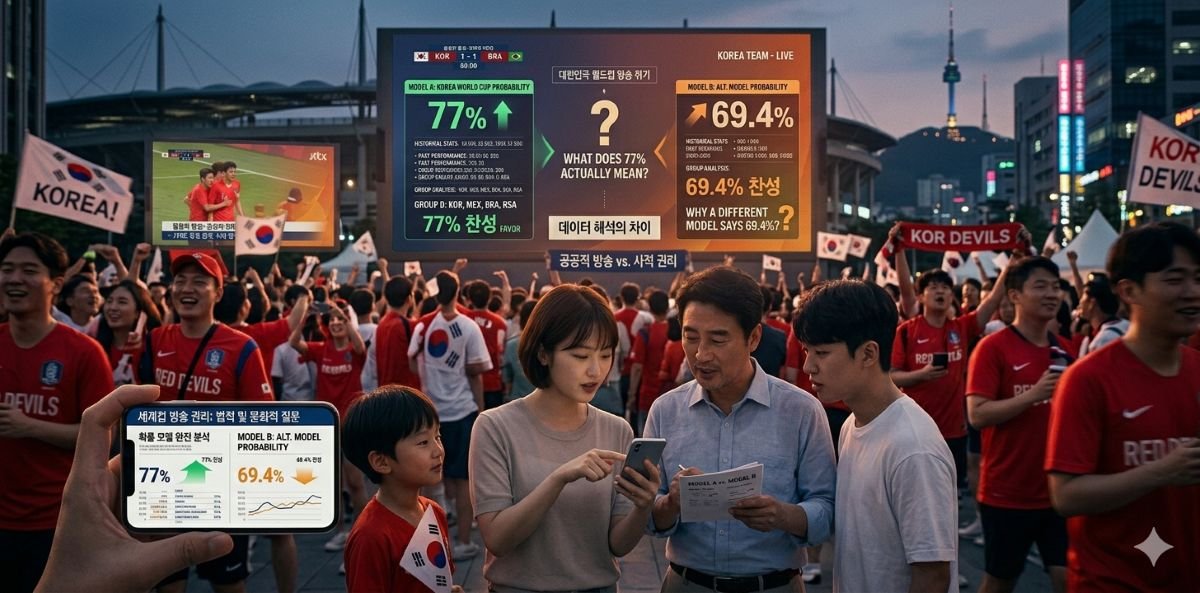
Two independent analytics outlets published probability estimates for South Korea’s 2026 World Cup group stage passage within the same week in early April, and they disagreed by 7.6 percentage points. Football Meets Data placed Korea’s advancement probability at 77%. Football Benchmark, using a methodology grounded in European market data, put the figure at 69.4%. Both are credible sources. Neither is wrong in any simple sense. And the gap between them tells you more about how football simulation models work than any single figure alone could.

Understanding why those numbers differ — and what each is actually measuring — is useful for any sports fan who wants to interpret probability figures critically rather than simply accepting them as fact.

What a Simulation Model Is Doing

A football simulation model is not a prediction. It is a probability-weighted forecast generated by running a match scenario many thousands of times, using historical data to assign each team a rating and then computing how often different outcomes occur across all those simulated runs.

The core inputs vary by model. A squad-based model assigns ratings to individual players, weights those ratings by expected minutes played, and uses the resulting team strength estimate to determine match probabilities. A market-based model derives implied team strength from how professional traders have priced the outcomes in liquid betting markets, treating that collective judgment as a more efficient signal than any individual analyst’s assessment.

Football Meets Data used a squad-based approach. For Korea’s 4.5 expected group stage points and 77% advancement figure, the model is reflecting the quality of players like Kim Min-jae (Bayern Munich), Son Heung-min (LAFC), and Lee Kang-in (PSG) relative to Czech Republic’s squad, which contains fewer players at that level of club competition.

Football Benchmark, using European market data, reached 69.4% — placing Korea third in Group A behind both Mexico (90.1%) and Czech Republic (80%). This ranking inverts the FIFA ranking order: Korea sits 25th globally, Czech Republic 41st. Yet Football Benchmark’s market-informed model rates Czech Republic as more likely to advance. The reason, which the analysts explicitly noted, is recent A-match performance. Korea lost 0-4 to Ivory Coast and 0-1 to Austria in March 2026 warmup matches. Czech Republic, meanwhile, demonstrated resilience and set-piece precision across two consecutive penalty shootout wins to qualify. Markets priced that recent evidence more heavily than squad depth.

Neither model is wrong. They are weighting different kinds of evidence.

Why the 48-Team Format Changes the Calculation

One structural element that makes Korea’s probability higher than it would be under previous formats is the expanded tournament structure. The 2026 World Cup includes 48 teams in 12 groups of four, with the top two from each group advancing automatically. Crucially, the eight best third-placed teams across all 12 groups also advance to the Round of 32.

Football Meets Data’s simulation found that Korea’s most likely group outcome is second place (30.8%), followed by winning the group outright (27.1%), finishing third (25.6%), and elimination in fourth (16.4%). With an expected points total of 4.5 — corresponding to a combination of one win and two draws or similar outcomes — Korea could finish third and still qualify if that points total compares favorably with other third-placed finishers from other groups.

This is a genuine format-driven shift. In the previous 32-team structure, finishing third would typically mean elimination. In 2026, it creates a genuine secondary qualification pathway, which raises every team’s overall advancement probability compared to equivalent historical tournaments. Any simulation model that properly accounts for this format will produce higher figures for teams in Korea’s position than older comparison data would suggest.

What the Numbers Do Not Tell You

Probability figures from simulation models are forward-looking estimates with known limitations that are worth naming explicitly. They assume that past performance is a reliable guide to future outcomes. They do not account for in-tournament factors: injuries during the group stage, weather, altitude in Mexico City, or the psychological dynamics of a squad playing in what may be Son Heung-min’s final World Cup appearance.

More specifically, a squad-based model can overestimate team strength if players are not playing regularly at club level. A market-based model can be distorted by public sentiment, particularly for teams with large supporter communities whose fans may skew betting markets toward optimism.

As examined in how football simulation models are built and applied at the analytics level, the gap between two credible models is itself the most informative signal — not the specific figures. When Football Meets Data produces 77% and Football Benchmark produces 69.4%, the honest interpretation is that Korea’s true probability lies somewhere in that range, and that the uncertainty between those endpoints reflects genuine analytical disagreement about how to weight recent poor form against structural squad quality.

Why Seongnam’s Football History Provides Useful Context

Seongnam FC’s analytical legacy is worth noting here. The club spent much of its peak era under Ilhwa ownership producing not just results but systematically superior squad construction — seven K League 1 titles and two AFC Champions League victories through an approach that was, for its era, among the most analytically grounded in Korean football. The city has a reasonable claim to being one of the more analytically literate environments for football discussion in Gyeonggi-do.

That context matters when reading probability figures about the national team. A 77% figure is not a promise. A 69.4% figure is not a pessimistic outlier. Both are estimates produced by models with different methodological assumptions, and the most useful response to both is the same: understand what each is measuring, recognize the range of uncertainty they collectively describe, and follow the tournament itself as the one simulation that actually counts.

Korea’s group stage matches begin in June. The models will have been right or wrong by July. In the meantime, the gap between those two numbers is the honest answer.

Read also: gwangjuinsider.com/접전은-정확성을-증명하지-않는다/

From Public Airwaves to Private Rights: What the JTBC Olympic Deal Means for How Korea Watches Sport

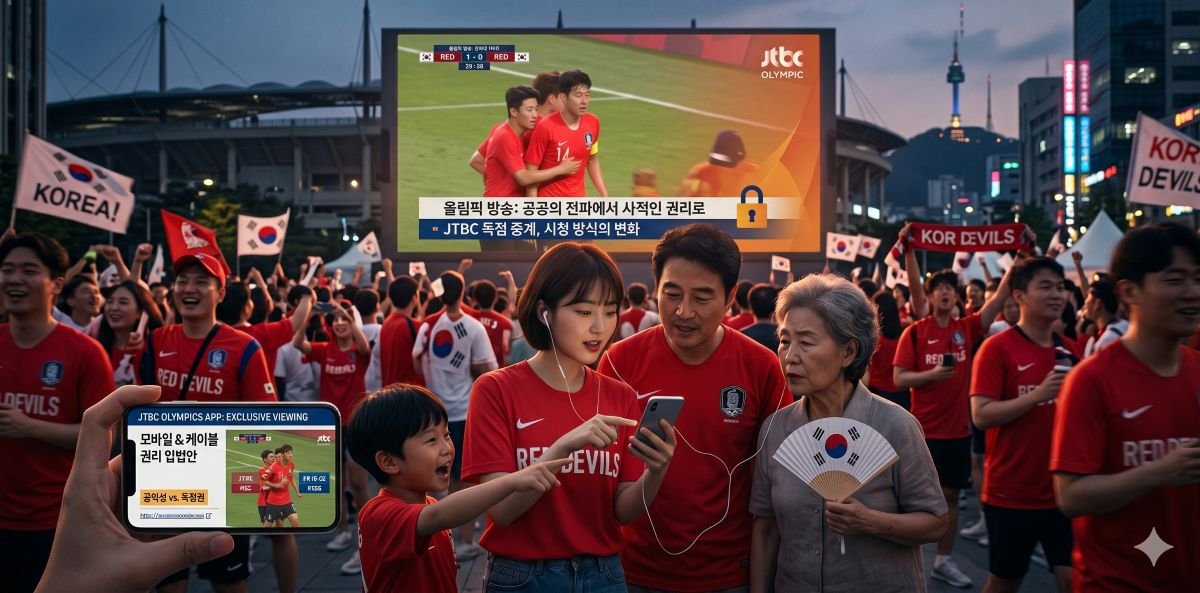
The agreement between the International Olympic Committee and JTBC, awarding the Korean broadcaster exclusive media rights for the Olympic Games from 2026 through 2032, was finalized through a competitive tender process that the IOC described as reflecting JTBC’s innovative broadcast plan and demonstrated commitment to Olympic values. The deal covers the Milano Cortina 2026 Winter Games, the Los Angeles 2028 Summer Games, and subsequent editions through 2032.

On paper, it is a straightforward commercial rights agreement between an international governing body and a domestic broadcaster. In practice, it represents one of the most consequential structural shifts in Korean sports media in decades — and the consequences are already visible in how millions of Koreans experienced the 2026 Winter Olympics.

The Architecture of the Deal

The IOC agreement with JTBC grants rights across all media platforms, with a specific mandate that at least 200 hours of Olympic Games coverage and 100 hours of Olympic Winter Games coverage must appear on national coverage television channels. JTBC committed to broad coverage across its linear, digital, and social media platforms, and to supporting the IOC’s year-round engagement objectives with younger audiences through the Olympic Channel.

JTBC’s media family — which includes JTBC2, JTBC3 FOX Sports, and JTBC Golf — gives the broadcaster a multi-channel infrastructure capable of distributing different sports and formats simultaneously. From a pure broadcast capacity standpoint, the organization has the technical means to deliver comprehensive Olympic coverage.

The IOC’s stated rationale for selecting JTBC over the existing consortium model centered on innovation and youth engagement. JTBC’s pitch emphasized digital-first delivery, direct fan relationships, and content formats designed to reach audiences who do not consume sport through traditional linear television.

What the Korea Pool Model Was and Why It Mattered

To understand what changed, it helps to understand what existed before. For decades, major international sports rights in South Korea were negotiated through the Korea Pool — a cooperative arrangement in which KBS, MBC, and SBS approached rights acquisitions collectively. The model distributed both the cost and the reach of major events across the three terrestrial broadcasters, each of which operates free-to-air channels accessible to effectively all Korean households.

Under the Korea Pool framework, the Olympics and World Cup were events that any Korean with a television could watch without additional cost or subscription. Coverage was not contingent on having a cable package, a streaming subscription, or a compatible device. The three networks competed on production quality and commentary rather than on access itself.

JTBC’s decision in 2019 to exit the Korea Pool and negotiate directly with the IOC broke that model. The broadcaster secured exclusive rights through a high-value independent bid, paying rates that the three terrestrial networks — already under significant financial pressure from declining advertising revenue — said they could not match and cannot now afford to pay as resale fees.

The 2026 Winter Olympics as a Case Study

The practical outcome became visible in February 2026. With resale negotiations between JTBC and the terrestrial broadcasters having collapsed, the Milano Cortina Winter Games aired exclusively on JTBC’s platform. The opening ceremony drew a 1.8 percent viewership rating — a number that reflects not lack of interest in the Olympics but lack of access to the channel carrying them.

For fans in Seongnam and across the Gyeonggi-do region, this was not an abstract policy outcome. It was a direct experience of exclusion from a national cultural event. The 200-hour linear television mandate in the IOC agreement was technically met. But the channel meeting that mandate was not one that all households could receive without a paid subscription.

The gap between the letter of the access requirement and the lived reality of viewers in mid-sized cities and regional communities is precisely what the current legislative debate around universal viewing rights is attempting to address. The Broadcasting Act amendment bill currently under consideration would define universal broadcasting access as coverage available in real time without additional cost burden, and would require 95 percent household reach for designated national events.

For a fuller understanding of how the K League and Korean domestic sports have navigated the relationship between broadcasting rights, league governance, and fan access at the regional level, the analysis at Seongnam Insider on legal battles over sports broadcasting in Korea provides directly relevant context on how these tensions have developed across different sports properties.

The Structural Question the Deal Raises

The JTBC Olympic rights agreement is not a villain’s story. It is the predictable outcome of a commercial rights market operating under competitive pressure, combined with a regulatory framework that had not anticipated the scenario it now faces. The IOC received a strong bid. JTBC invested in a long-term partnership. The existing legal architecture had no mechanism to compel a different outcome.

What the deal has done is clarify, with unusual sharpness, the difference between access as a market outcome and access as a civic entitlement. For regional communities across Gyeonggi-do where infrastructure gaps mean digital alternatives are less reliable, that distinction matters in concrete terms.

For broader context on how broadcasting policy frameworks evolve in response to market developments and why regulatory formalization tends to follow rather than anticipate structural shifts, 시스템 운영의 공식화와 규칙 투명성의 구조적 진화 offers structural framing on the institutional dynamics at work in situations exactly like this one.

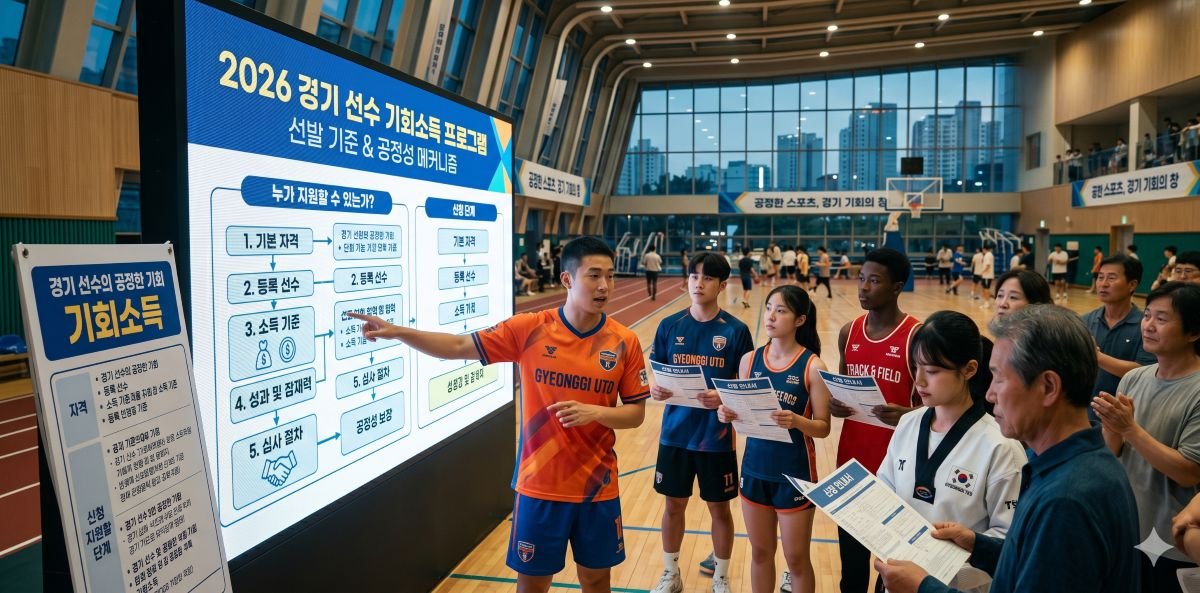
The Mechanics of Fairness: Who Qualifies for Gyeonggi Province’s 2026 Athletes’ Opportunity Income Program

Gyeonggi Province has opened applications for its 2026 Athletes’ Opportunity Income program, a policy instrument designed to provide financial support to professional and semi-professional athletes whose sporting activity generates social value for their communities. The program represents a meaningful attempt to address one of the structural vulnerabilities in Korean athletic careers: the gap between the visibility of sport and the economic precarity of the people who practice it at levels below the top professional tier.

But the program’s design contains a geographic boundary that raises substantive questions about how fairness is defined in provincial sports policy — and what it means for athletes in Seongnam, Yongin, and Goyang, who are currently excluded from eligibility.

What the Program Is Designed to Do

The Athletes’ Opportunity Income program operates on a principle that has gained traction in Korean sports policy in recent years: that athletes who contribute to community life through sport — through participation, visibility, youth development, and local identity — create value that the market does not automatically compensate. A semi-professional footballer competing in a lower league, a track athlete representing a regional club, a basketball player whose career exists outside the commercial spotlight of the KBL — all of these individuals generate social goods that are difficult to price but real in effect.

The program responds to this by providing income support that is not tied to contract value or commercial success, but to the act of competitive athletic participation itself. It is closer in concept to a civic recognition of athletic labor than to a performance bonus or prize fund.

For athletes in eligible areas of Gyeonggi-do, this represents a meaningful safety net. Professional sports careers in Korea — outside the handful of highest-profile leagues — frequently involve financial instability, short career windows, and limited post-career support. A provincial income supplement does not resolve those structural problems, but it addresses one dimension of them directly.

The Exclusion and Its Logic

Seongnam, Yongin, and Goyang are currently not included in the eligible applicant pool. The administrative reasoning behind this exclusion reflects a tiered model of local government capacity that is embedded in Korean provincial governance.

Seongnam is classified as a large-scale city — a designation that carries implications not just for administrative structure but for fiscal responsibility. Large-scale cities in South Korea operate with greater budget autonomy than smaller municipalities, maintain more developed local infrastructure, and are generally expected to fund sports and cultural programs from their own resources rather than relying on provincial redistribution.

From the province’s perspective, the exclusion is a resource allocation decision. If Seongnam’s municipal budget already supports substantial sports infrastructure — including institutions like Seongnam FC and associated athletic programs — then directing provincial funds toward athletes in that city represents a less efficient use of redistributive policy than directing them toward athletes in smaller districts with fewer local resources.

The logic is internally coherent. But it produces a concrete inequity at the individual level: two athletes of equivalent status, competing at equivalent levels, generating equivalent social value through their sport, may have access to very different levels of financial support depending purely on which city within Gyeonggi Province they happen to live in.

What Seongnam Athletes Navigate Instead

For athletes based in Seongnam who fall outside the provincial program’s eligibility criteria, the relevant support structures exist at the municipal level rather than the provincial one. Seongnam’s own sports administration budget and any locally operated athlete support programs become the primary recourse.

This creates an administrative navigation challenge that requires athletes and their clubs to understand not just whether support exists, but which level of government administers it, under what criteria, and through which application channels. The gap between provincial and municipal frameworks is not always visible from the outside — and for athletes focused on training and competition rather than bureaucratic research, it can result in support going unclaimed simply because the right pathway was not identified.

It also raises a question about whether the large-scale city classification, which was designed around fiscal capacity and administrative infrastructure, is the right proxy for determining individual athlete need. A city’s aggregate sports budget tells you something about institutional capacity. It does not tell you much about the financial circumstances of a semi-professional athlete living in that city.

The Broader Governance Question

The Gyeonggi Athletes’ Opportunity Income program sits at the intersection of sports policy, regional equity, and the ongoing Korean conversation about what public support for athletes should look like. For a fuller picture of how Korean sports governance structures shape the financial landscape for athletes and clubs at different competitive levels, the analysis at Seongnam Insider on K League financial regulations provides useful context on how funding frameworks operate across Korean football’s tiered system.

The program’s exclusions are not arbitrary — they reflect real distinctions in how Korean local government is structured. But they are worth examining carefully, because the principles embedded in policy design shape who benefits and who navigates the system alone.

For broader context on how regional governance structures and sports subsidy debates play out in practice, 정책 논쟁이 경기장을 넘어서는 지점 offers relevant framing on how institutional constraints shape what support reaches athletes and communities at the local level.

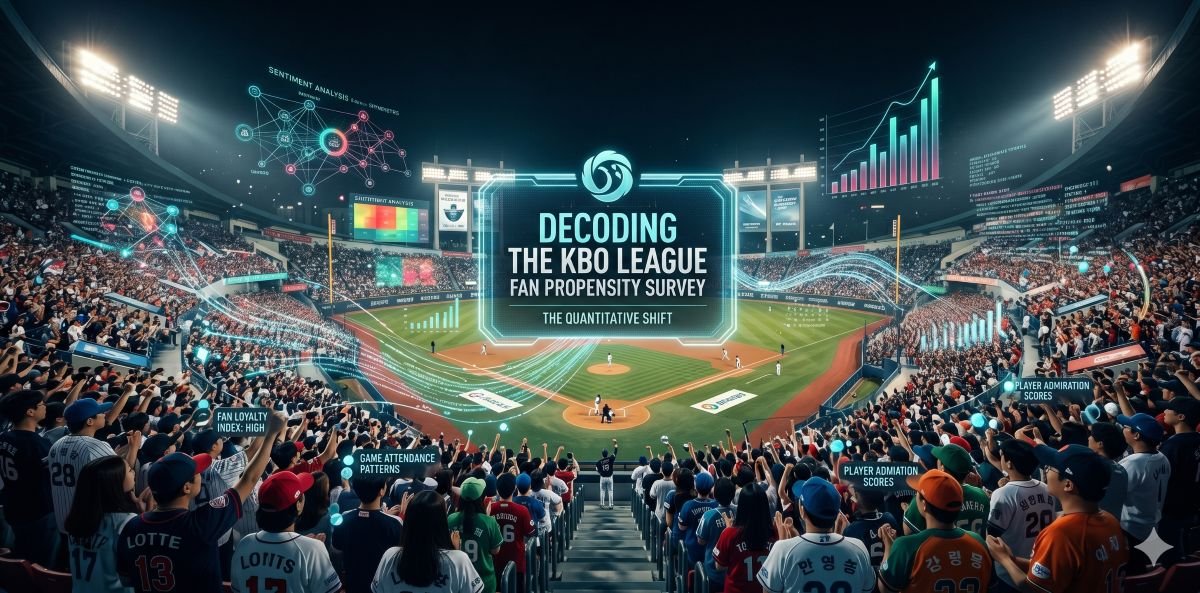
The Quantitative Shift: Decoding the KBO League Fan Propensity Survey

The 2026 KBO season is proving to be a landmark year for the integration of technology and sports, but the most significant changes might be happening away from the pitcher’s mound. With a critical April 15 deadline approaching, the Korea Baseball Organization has officially opened the bidding process for a comprehensive fan propensity survey and analysis. This initiative represents a departure from the days of simply counting ticket stubs at the gate, moving instead toward a sophisticated, data-driven understanding of how fans actually consume the sport.

For the community in Gyeonggi-do, particularly those who frequent the sports hubs around Seongnam, this “Quantitative Shift” is more than just an administrative task. it is a signal that the league is beginning to view its audience not just as spectators, but as vital data points within a complex engagement ecosystem.

Moving Beyond Attendance Tracking

Historically, the success of a baseball season was measured by attendance figures and television ratings. While these metrics provided a general sense of popularity, they offered very little insight into the “why” behind fan behavior. Why does a fan choose to watch on their phone instead of at the stadium? What specific moments in a game lead to the highest levels of “viewing satisfaction”?

The 2026 survey aims to answer these questions by quantifying consumption importance across both digital and physical platforms. By analyzing spectator characteristics, the KBO hopes to build a profile of the modern fan that accounts for their digital habits, regional loyalties, and even their reaction to new rules like the Automated Ball-Strike (ABS) system. For fans in Seongnam, where tech-savviness is a local hallmark, this data will likely highlight a high preference for integrated digital experiences.

The Ecosystem of Engagement

When we speak about a “broader engagement ecosystem,” we are referring to the idea that a fan’s relationship with the KBO does not start and end at the stadium gates. It includes social media interactions, highlights watched on the subway, and the use of sports analytics platforms. The KBO’s bidding project seeks to map this entire journey.

By understanding the “viewing environment,” the league can better optimize the rhythm of the game. If data shows that fans are losing interest during specific lulls in play, the league has the empirical evidence needed to adjust pace-of-play regulations. This is a far more reliable method than relying on historical assumptions or anecdotal complaints from the dugout. It is a transition toward a 스포츠 분석 방법론-데이터 맥락 전략을 평가하는 방 (sports analysis methodology) that treats the audience as a core variable in the game’s success.

Impact on Seongnam-Based Fan Clusters

Seongnam sits at a unique intersection of sports culture and technological innovation. Residents here are often early adopters of the very digital platforms the KBO is now trying to analyze. Because Seongnam fans often balance their loyalty between local institutions like Seongnam FC and the national fever of the KBO, their consumption patterns are highly diversified.

The results of this propensity study will likely influence how media rights are distributed in the Gyeonggi region. If the data reveals a heavy lean toward interactive streaming in tech-heavy districts, we may see more localized digital content or “smart stadium” initiatives tailored to these specific clusters. This data-driven approach ensures that the league’s evolution remains grounded in the actual needs of the community. To better understand how the league manages these shifts, one can look at a guide to the K-League’s financial regulations for Seongnam fans, which illustrates how structured data and rules guide the business side of Korean sports.

Transparency as a Strategic Asset

The April 15 deadline for the bidding process is the first step in a larger push for transparency and efficiency. By hiring external experts to conduct this analysis, the KBO is ensuring that the data is handled with professional objectivity. This is vital for maintaining trust with the fans. When the league makes changes to the schedule or the broadcast format, they can point to the propensity survey as the “source of truth” behind those decisions.

For the analytically minded fan, this is a welcome change. It removes the mystery from league governance and replaces it with a logic that mirrors the statistical depth of the game itself. Just as a manager uses a pitcher’s “spin rate” or “exit velocity” to make a mid-game substitution, the KBO will use “viewing satisfaction” metrics to make mid-season adjustments to the fan experience.

Looking Toward the 2026 Post-Survey Era

Once the bidding process is finalized and the study is conducted, the 2026 KBO season will move into a new era of sports management. We can expect to see a more personalized approach to fan engagement, where the “one size fits all” model of the past is replaced by targeted strategies that recognize the differences between a casual viewer in a rural province and a data-heavy fan in a city like Seongnam.

The Quantitative Shift is an acknowledgement that in the modern era, the fan is an active participant in the league’s infrastructure. By the time the next season rolls around, the “rhythm of the game” will have been fine-tuned by the very people who watch it, ensuring that Korean baseball remains as relevant in the digital world as it is on the diamond.

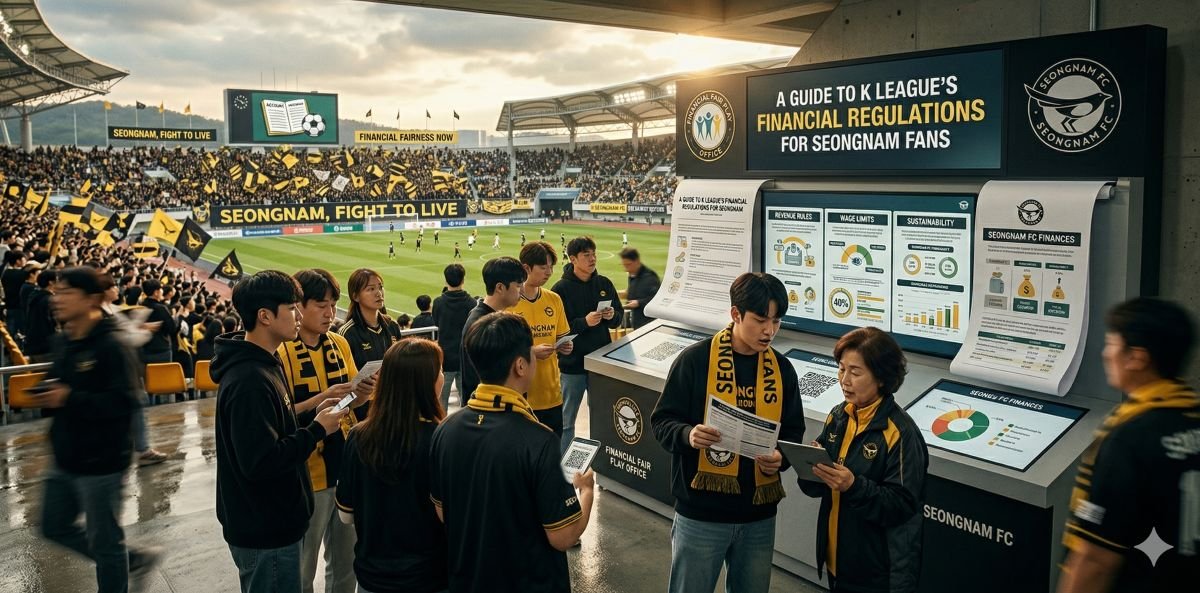
A Guide to the K League’s Financial Regulations for Seongnam Fans

As the 2026 K League 2 season enters its decisive middle phase, the conversation among supporters of clubs like Seongnam FC and Suwon Samsung Bluewings often centers on roster depth and transfer activity. However, behind every high-profile signing and contract extension lies a complex web of governance known as the Financial Sustainability Regulations (FSR).

In an era where global football is frequently disrupted by the boom-and-bust cycles of purely commercial ownership, the K League has adopted a more cautious, architecturally sound model. These regulations are not merely administrative hurdles; they are the structural safeguards that ensure regional clubs remain permanent fixtures of their communities. For the sports-literate fan in Gyeonggi-do, understanding the K League’s fiduciary framework is essential to grasping how their club is being built for the next decade.


The Philosophy of the “Soft Cap” and Luxury Tax

Unlike the “Hard Cap” systems found in North American sports like the NFL, or the relatively loose “Financial Fair Play” (FFP) rules in Europe, the K League utilizes a “Soft Cap” mechanism. This system is designed to allow ambitious clubs to spend on talent while ensuring that such spending does not destabilize the league’s competitive equilibrium.

The league sets a wage threshold tied to a percentage of the collective average revenue of the member clubs. If a club’s total player salary expenditure exceeds this threshold, they are not barred from competing; instead, they are required to pay a “Luxury Tax.”

This tax serves a dual purpose:

  1. Redistribution: The funds collected from high-spending clubs are redistributed among clubs that operate within their means, effectively subsidizing the “middle class” of the league.

  2. Market Correction: It forces ownership to calculate the “true cost” of a star player. A 1 billion KRW salary might actually cost the club 1.2 billion KRW once the tax is applied, incentivizing a more rigorous approach to scouting and data-driven recruitment.

This regulatory approach is a regional manifestation of how global legal models and structural differences in governance shape the way entertainment and sports industries operate. By prioritizing sustainability over unchecked growth, the K League ensures that clubs don’t “over-leverage” their future for a single season of success.


Homegrown Incentives: The U-22 Rule as a Financial Tool

A cornerstone of the K League’s financial architecture is the Under-22 (U-22) Rule. While fans often view this through a tactical lens—requiring teams to start at least one U-22 player to unlock their full substitution quota—the rule is fundamentally a financial sustainability mechanism.

For a club like Seongnam FC, which boasts one of the most respected youth academies in the Gyeonggi-do region, this rule provides a direct financial advantage. By promoting “homegrown” talent into the first team, the club can manage its wage bill more effectively. Homegrown players typically command lower initial salaries compared to established veterans or international signings, yet they provide high-value output.

The K League further incentivizes this by offering roster-spot allowances and financial grants to clubs that exceed minimum requirements for youth integration. This creates a “virtuous cycle”:

  • Reduced Transfer Fees: Developing talent internally reduces the need for expensive domestic transfers.

  • Asset Appreciation: Successfully integrating a young player increases their market value, providing the club with a potential “transfer profit” in future windows.

This focus on internal development is deeply connected to the broader evolution of the club’s identity, as explored in our report on the color of governance and the Seongnam FC civic club shift. When a club is viewed as a public asset, its primary duty is to foster local talent rather than importing expensive, short-term solutions.


The Revenue-to-Expense Ratio: Engineering Long-Term Viability

The ultimate goal of the FSR is to prevent a “financial cliff.” The league monitors each club’s Revenue-to-Expense ($R:E$) Ratio to ensure that operational costs are supported by genuine income streams (sponsorships, broadcasting rights, and match-day revenue) rather than unsustainable debt.

In a healthy club model, the ratio is ideally:

$$R_{total} \geq E_{operations} + E_{wages} + E_{debt\_service}$$

If a club’s expenses consistently outpace its revenue, the league can mandate “Budget Corrective Actions.” These might include a freeze on new signings or a requirement for the parent company (or municipal government) to provide a “Stability Guarantee.”

This level of oversight is particularly critical for clubs in Gyeonggi-do, where the “derby” culture between Seongnam, Suwon, and Anyang creates immense pressure to win immediately. The FSR acts as a “speed governor,” ensuring that the local rivalry remains a healthy sporting competition rather than a financial arms race that could bankrupt a regional institution.


Why the Fan Should Care

For the entry-level fan, these rules might seem like “back-office” concerns. However, the FSR directly impacts the product on the pitch. It ensures that when you buy a season ticket for Seongnam FC, you are investing in a club that will still exist ten, twenty, or fifty years from now.

By prioritizing the “Homegrown” player and enforcing a “Luxury Tax,” the K League has created a system where survival is predicated on intelligence, scouting, and community integration rather than just the size of an owner’s bank account. This is the essence of modern sports literacy: recognizing that the most successful clubs are not always the ones that spend the most, but the ones that understand the architecture of the system they play in.

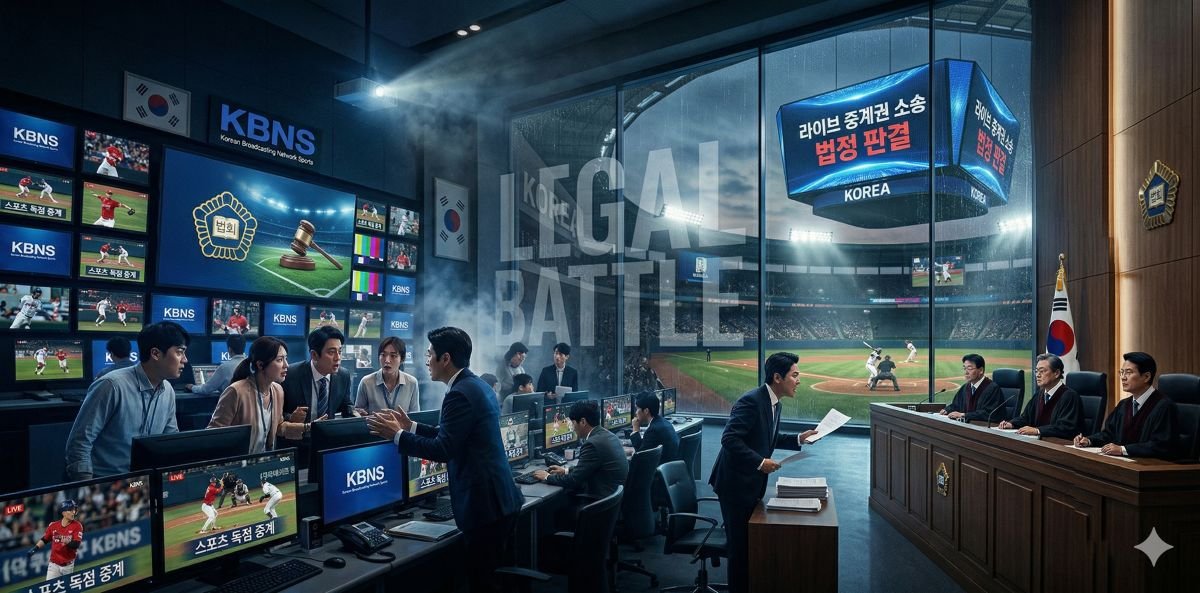
The Legal Battle Over Sports Broadcasting in Korea

Over the past 48 hours, a significant regulatory discussion has intensified within the Korea Communications Commission (KCC) that could redefine the relationship between South Korean citizens and their favorite pastimes. At the heart of the debate is the concept of “Universal Access Rights” ($보편적 시청권$), a legal framework designed to ensure that the public can view culturally significant events without being barred by excessive costs or technical hurdles.

As major sports entities—most notably the KBO League and K League—transition their primary broadcasting rights to exclusive, paid over-the-top (OTT) streaming platforms like TVING and Coupang Play, a fundamental legal conflict is emerging. This tension pits the private property rights and commercial autonomy of sports leagues against the public’s right to access content that serves as a cornerstone of national and regional identity.


Defining the “National Interest” in the Digital Age

Under current South Korean law, the KCC mandates that certain “events of national interest” must be accessible to at least 90% of the population via free-to-air, terrestrial signals. Historically, this designation has been reserved for global spectacles such as the Olympic Games and the FIFA World Cup qualifiers.

However, the current regulatory review is exploring whether this definition is outdated. Proponents of expanded access argue that professional sports leagues, which operate on land and within infrastructures often supported by public funds, should also be considered essential cultural goods. For residents of Seongnam, a city with a deeply ingrained football and baseball culture, the outcome of this debate will determine whether following their local team remains a public right or becomes a private luxury.

The KCC is currently weighing the inclusion of “core league matches” under the universal access umbrella. This would legally require streaming giants to sub-license certain games to terrestrial broadcasters, ensuring that fans who cannot afford multiple monthly subscriptions—or those who lack the digital literacy to navigate complex apps—are not left in the dark.


The Digital Paywall Shift: A Barrier to Community Engagement

For many Seongnam residents, the shift from linear television to OTT services represents more than just a change in technology; it is a barrier to community-wide sports engagement. Traditional broadcasting served as a “water cooler” medium—an accessible, synchronized experience that allowed different generations to connect over a shared event.

The migration to paid digital streaming creates a fragmented audience. When a match is placed behind a paywall, it naturally excludes lower-income households and older demographics who may find the transition to smartphone-based viewing cumbersome. This tension highlights how legal structures shape user behavior, as the presence or absence of a paywall dictates who can participate in the cultural conversation and who is relegated to following via text-based updates.

In a city like Seongnam, where sports have historically functioned as a “social glue,” this exclusion has sociological consequences. If a significant portion of the city can no longer watch a local derby or a championship race, the collective identity associated with those teams begins to erode.


Regulatory Balance: Innovation vs. Public Good

On the other side of the legal aisle, sports leagues and broadcasting partners argue that the “Universal Access” mandate could stifle “Digital Innovation.” The K League and KBO have argued that the revenue generated from exclusive OTT deals is vital for the survival and modernization of the sport. These funds are used to improve stadium facilities, invest in youth academies, and enhance the quality of the broadcast through advanced analytics and high-definition production.

Leagues contend that forcing them to provide free access undermines their private property rights. They argue that in a free-market economy, the value of their “product” (the game) should be determined by what platforms are willing to pay for it.

Legislators are therefore tasked with a difficult balancing act:

  • Encouraging Private Investment: Ensuring leagues have the capital to compete on a global scale.

  • Protecting Cultural Rights: Ensuring that the most marginalized members of the community are not excluded from the national sports narrative.

This debate is particularly resonant for supporters of civic-minded organizations, as seen in the discussion regarding the color of governance and the Seongnam FC civic club shift. When a club’s identity is rooted in its relationship with the city’s taxpayers, the argument for keeping its matches accessible to those same taxpayers becomes legally and ethically stronger.


The Path Forward for Seongnam Fans

As the KCC continues its review over the coming months, the results will likely lead to a new “hybrid” model of sports media. We may see a future where the majority of games are hosted on premium digital platforms, while a “protected quota” of matches is mandated for free public viewing.

For the readers of SeongnamInsider, this legal battle is a reminder that sports are not just games played on a field; they are governed by a complex web of media laws and civic responsibilities. Understanding these frameworks is essential for any fan who wants to advocate for a sports ecosystem that is both innovative and inclusive.

The “Universal Access” debate reminds us that the value of a sport is not just found in the revenue it generates, but in the number of people who can share in the experience. As we move further into the digital age, the challenge for regulators will be to ensure that while the technology changes, the “social glue” of sports remains as strong as ever.

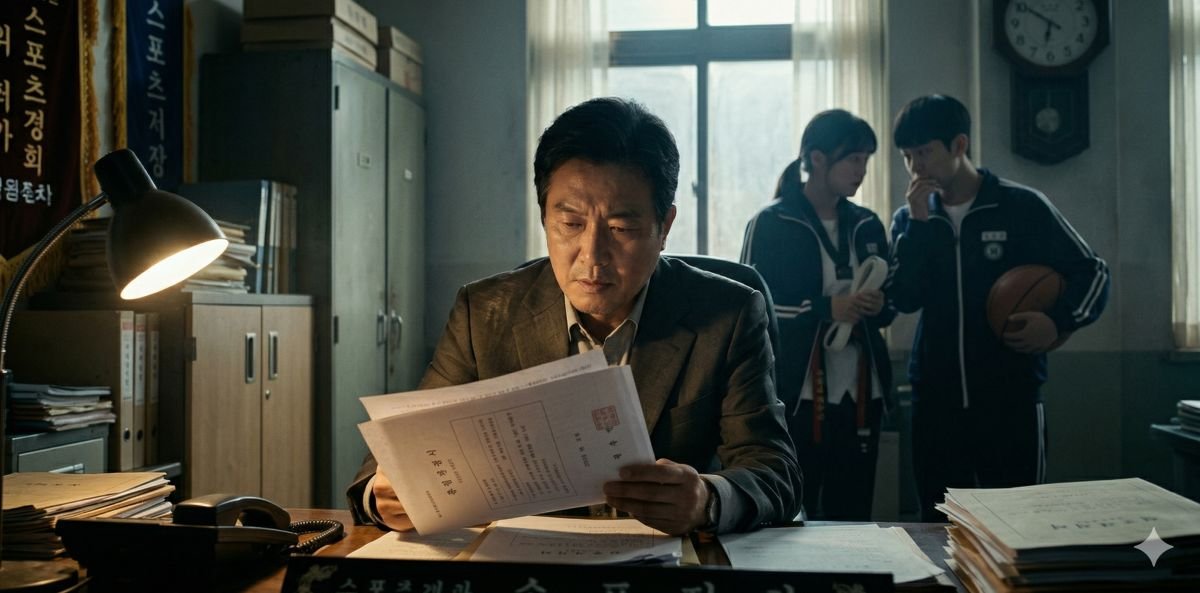
Korea’s Student-Athlete Education Debate Has Intensified — What the Policy Dispute Reveals About How Korean Sport Is Governed

At a moment when school sports participation is declining and the government remains deadlocked over reforms that satisfy neither side, the debate over student-athlete education in Korea is not simply a dispute over education policy — it is raising fundamental questions about how Korean sport should be governed.

The Background — A Collision of Two Values

The question of education for Korean student-athletes has long maintained tension between two competing values. One is the national imperative to develop elite athletes capable of producing top results in international competition. The other is the human rights demand that students with athletic ability must also be guaranteed their basic right to education.

The current system has historically weighted the former. Talented students are identified at an early age and channeled into intensive training programs, supported by educational concessions such as reduced class hours and university admission based on athletic performance. This structure has been credited with contributing to Korea’s consistent placement at the top of medal tables at the Olympics and Asian Games.

However, the same structure has faced sustained criticism on other grounds. Student-athletes are having their right to education violated, and their career options beyond sport are being structurally constrained.

The National Human Rights Commission’s Recommendation and the Reform Trajectory

A significant turning point in this debate came in 2007, when the National Human Rights Commission of Korea issued a recommendation urging a departure from the elite-centered system. The substance of that recommendation was that student-athletes should have the same opportunity to attend classes as general students, and that the practice of substituting athletic performance for academic obligations needed to be fundamentally reconsidered.

Reform momentum continued steadily from that point. Institutional changes were applied in stages, including the introduction of minimum academic standards, a shift toward weekend league competition formats, and limits on missed classes. However, these changes drew resistance from both sides of the debate. The elite sports camp warned of weakening competitive capacity, while the education-centered reform camp criticized the changes as insufficiently fundamental.

A Government in Deadlock — Two Ministries at Different Temperatures

The current situation is close to a policy vacuum. Sports Minister Chae Hwi-young stated at his confirmation hearings that he would discuss relevant legislative revisions with the Education Ministry. Education Minister Choi Kyo-jin emphasized the need to balance academics and athletics. Yet neither ministry has presented a concrete and clear policy direction.

What this deadlock signals is not simply that administrative processing is slow. It exposes a more fundamental problem: how legal structures define the behavior and choices available to participants. The rules applied to student-athletes shape their career trajectories, their educational experiences, and their entire relationship with sport. Analysis of how legal structures shape the behavior of sports participants helps situate this governance dispute in a broader context.

Declining School Sports Participation — A Structural Outcome

Behind the intensifying debate lies an actual decline in school sports participation. The structure that forces students to choose between an elite training pathway and a general academic pathway is becoming a factor that drives many students away from sport altogether. The practical concern that joining a school athletic program will cause academic delays, combined with the sunk cost pressure that abandoning sport means losing already-invested time — these two forces are pushing students away from sport.

In communities like Seongnam, where civic club sports culture carries particular weight, this problem is felt more directly. The way local sports clubs connect with school sports programs, and the process by which young athletes make career decisions, affects the entire sports culture of the local community. Seongnam Insider’s coverage of local sports policy and youth community issues provides context for understanding how this structural debate manifests at the community level.

A Comparative Perspective — How Other Countries Approach This

The student-athlete education problem is not unique to Korea. The American NCAA system has institutionalized a structure for combining academics and athletics at the university level, but it has not escaped controversy over athlete exploitation and educational quality. Germany’s elite sports school model is designed to integrate academic study with training. Japan has normalized school sports through the bukatsu club activity culture, but the problem of excessive training burdens has become a subject of social debate.

What the examples from each country consistently demonstrate is that no single model is perfect. The balance between elite performance and the guarantee of educational rights depends on each society’s value judgments and its capacity for institutional design. The UNESCO international policy guidelines on the integration of sport and education present international standards for how this balance can be approached.

Reading This Debate as a Governance Question

Reading the student-athlete education debate as merely a jurisdictional dispute between the Education Ministry and the Ministry of Culture, Sports and Tourism is a surface-level understanding. The substance of this debate is a governance question: around what values should Korean sport be operated?

A system that places elite performance as the top priority can deliver medals, but it turns away from the experiences and rights of students who fall through the gaps of that system. Reform that prioritizes educational rights can create an environment where more students continue in sport, but securing top-level competitiveness may take longer.

How the government resolves this conflict will determine the structural direction of Korean sport going forward. The longer time passes without a clear policy direction, the more the cost of that vacuum is paid by student-athletes who are being forced to make choices outside the boundaries of any coherent system.

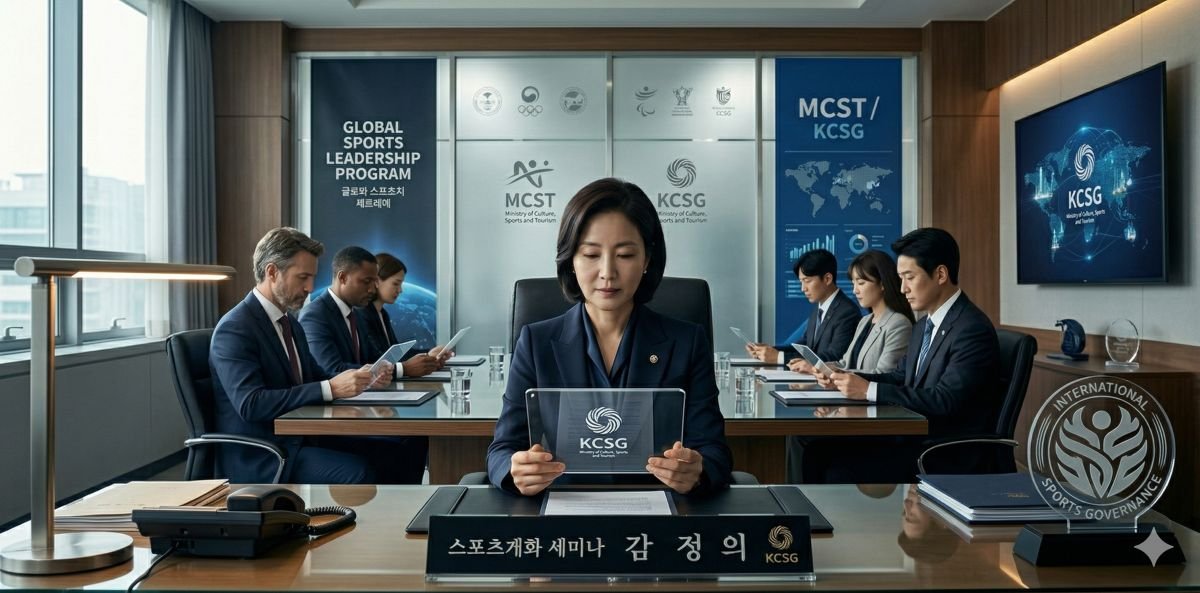
Korea’s Ministry of Culture Is Launching a Global Sports Leadership Program — What It Reveals About How Korea Positions Athletes in International Governance

South Korea’s Ministry of Culture, Sports and Tourism has launched a program to systematically train high-level personnel targeting senior positions in international sports organizations — a move that is part of a national strategy to convert on-field performance into institutional influence beyond the arena.

The Program’s Background

The Ministry of Culture, Sports and Tourism announced the establishment of a Global Sports Leadership Course in partnership with the National Sports Promotion Foundation. Recruitment for the first intake runs from April 8 to 30. The program’s stated purpose is to develop high-level human resources in the international sports sector, targeting sports administrators and athletes, international judges, and government and corporate officials aiming for senior positions in international sports organizations.

There is a clear premise behind this program. Korea has consistently placed at the top of medal tables at the Olympics and World Championships, demonstrating world-class performance on the field of play. However, the Ministry’s assessment is that Korea’s institutional standing within the International Olympic Committee, international federations, and other global sports organizations falls significantly short of what that performance record warrants. The election of Won Yoon-jong as an IOC Athletes’ Commission member represents meaningful progress in this context — but it also confirms that Korea’s on-field achievements have outpaced its institutional influence.

The Athlete-Preference Structure — Designed Around How the IOC Actually Works

The eligibility and financial support structure of the Global Sports Leadership Course is designed to reflect the actual power dynamics of international sports organizations. The fact that approximately 40 percent of IOC members are former Olympians underpins the program’s core design logic.

Specifically, Olympic and World Championships winners receive full coverage of education expenses. Asian Games winners receive half of education expenses. Sports-related career background and job suitability are used as evaluation criteria, signaling that this is not a general administrative training course but a structured pathway designed to move individuals with direct competitive experience into the decision-making architecture of international organizations.

This structure illustrates clearly how fairness can carry different meanings across different institutional contexts. The analysis of why fairness means different things across different regions and institutions provides useful context for understanding why this program has set competitive athletic careers as a preferred qualification. The principle that individuals with on-field credibility carry greater institutional trust is not a new invention — it is how international sports organizations have long operated.

What Won Yoon-Jong’s IOC Election Opened Up

One of the direct catalysts for this program is the election of Won Yoon-jong to the IOC Athletes’ Commission. A former national bobsled team member, Won’s election marked a symbolic milestone in Korea’s entry into international sports governance.

The Ministry interpreted this development as evidence that Korea’s on-field achievements are running ahead of its institutional influence. In other words, the ability to win medals and the ability to participate in policy decisions within international sports organizations are distinct competencies — and the latter requires systematic development. The Global Sports Leadership Course is the institutional response to that gap.

Reading This Policy Through the Lens of Seongnam

Seongnam occupies a distinctive place in the history of Korean civic sports culture. Seongnam FC, as a civic club, represents a case study in how the relationship between local communities and sports institutions should function. Stronger Korean representation in international sports governance has indirect but real implications for local sports ecosystems like Seongnam’s. The policy decisions made at the IOC and international federation level filter down into domestic sports institutional design, and from there into how regional clubs and community sports cultures are structured and resourced. Seongnam Insider’s coverage of local sports policy and civic community context provides a useful reference for understanding what this national-level governance discussion means at the community level.

International Sports Governance — Why Institutional Access Matters

Influence within international sports organizations is not simply about securing favorable treatment for one’s own athletes. Holding committee positions and executive board seats at the IOC, FIFA, FIBA, World Athletics, and similar bodies means having a seat at the table when decisions are made about competition rules, host city selection, anti-doping policy, and broadcast rights distribution — decisions with strategic and financial implications that extend far beyond any single event.

Korea’s rationale for strengthening its institutional foothold in this space is clear. World Cup qualification confirmed, Asian Games medal competition ongoing, sustained performance across Olympic disciplines — converting this accumulated on-field capital into genuine decision-making authority within the international sports order requires personnel with competencies spanning administration, diplomacy, law, and media, positioned inside international organizations.

Academic background on Olympic governance and the structure of international sports organizations is available through the International Olympic Committee’s official academic resources and Olympic Studies Centre. Analysis of IOC member composition, the role of athletes’ commissions, and national participation patterns in governance provides a meaningful reference point for understanding why this program has been launched at this moment.

Institutions Shape Culture

More important than how many international organization executives this program produces in the short term is the fact that it establishes international governance participation as a legitimate career pathway within Korean sports culture.

When it becomes natural for elite athletes to move from retirement into roles representing Korean sports interests within international organizations, Korea’s institutional asset base grows alongside its competitive performance. Building a structure in which on-field achievements translate into institutional standing beyond the arena — this is the direction of change the program is designed to produce.

Korea has long known how to win. What this program signals is that the country has decided it also needs to learn how to govern.

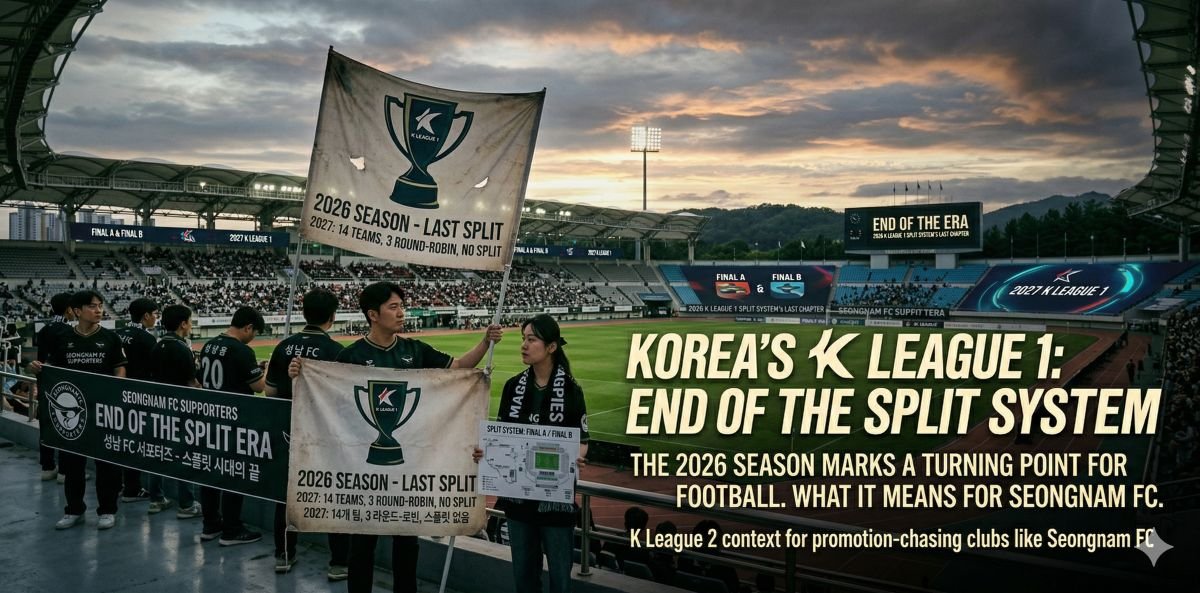
2026 Is the Last Season of the K League Split System — What That Means for How Korean Football Determines Its Champion

The 2026 K League 1 season marks the end of an era. The split system — the format that divides the league into Final A and Final B groups after the regular round — will be retired after this season concludes. From 2027, K League 1 expands to 14 teams and moves to a full three round-robin structure with no split. For Seongnam FC supporters following the club’s push for promotion through K League 2, understanding how the current system works and why it is being phased out is essential context for reading this season.

How the Split System Was Built

The split system was introduced in 2012 when K League 1 operated with 16 teams. It moved to a 14-team structure in 2013, then settled into the 12-team format it has maintained since 2014. The core mechanism divides clubs after the regular round based on their standings. The top six sides enter Final A, where they compete for the title, AFC Champions League places, and safety. The bottom six enter Final B, where the primary stakes are avoiding relegation.

The design logic was straightforward: keep competitive pressure meaningful for more clubs deeper into the season. A team outside the top six still has something to fight for in Final B, while clubs in Final A cannot coast once the split is confirmed. On paper, the format addressed a common problem in leagues where the title and relegation races lose tension before the season ends.

Why the Format Is Being Retired

Despite its intentions, the split system accumulated sustained criticism over its years of operation. The method by which regular-season points carry over into the final rounds created confusion around standings and perceived fairness. The unequal number of matches between groups introduced imbalances in scheduling. More structurally, a 12-team league produces a limited volume of fixtures, which constrains both competitive density and broadcast appeal across a full season.

The replacement format addresses these problems directly. Fourteen teams competing across three full round-robins produces significantly more matches, maintains consistent standings throughout the season, and removes the visual and administrative complexity of a mid-season split. The final table reflects cumulative performance across the entire campaign rather than a segmented structure. For sports analysis purposes, a format without a split generates cleaner data across a longer competitive window, which matters for how performance trends are evaluated across a season.

What This Means for K League 2 and Seongnam FC

Seongnam FC enter the 2026 K League 2 season under head coach Jeon Kyung-jun with a clear objective: finish in the top two. First and second place in K League 2 earn automatic promotion to K League 1. That promotion target is the lens through which this entire season should be read. A full breakdown of how the promotion and relegation system works in 2026 is available in this guide for Seongnam FC fans.

The 2026 K League 2 season also introduces a structural change of its own. For the first time, promotion and relegation between K League 2 and the K3 League becomes a formal mechanism. The bottom-placed K League 2 club will face the K3 League champion in a single-match playoff. This means competitive pressure exists at both ends of the K League 2 table simultaneously. No club can treat the lower half of the standings as safe ground. The league-wide tension this creates is a meaningful shift from previous seasons.

For a deeper look at how data and context shape the way competition formats are evaluated across Korean football, this analysis from Seoul Monthly examines the methodology behind sports structural assessment.

The Final Season of a Format

When the 2026 K League 1 season ends, the split system goes with it. Final A and Final B will no longer exist as categories. The clubs that spent more than a decade operating within this structure will enter 2027 under entirely different competitive conditions.

For Seongnam supporters, the timing carries particular weight. If the club secures promotion through K League 2 this season, they will be entering a K League 1 that is itself preparing for transformation. Understanding the format being left behind is part of understanding the one being built in its place.

Format shapes outcome. A league that splits its clubs mid-season produces a different kind of champion than one that runs its full course uninterrupted. Korean football is choosing the latter from 2027 onward, and 2026 is the last season to watch the former play out in real time.