
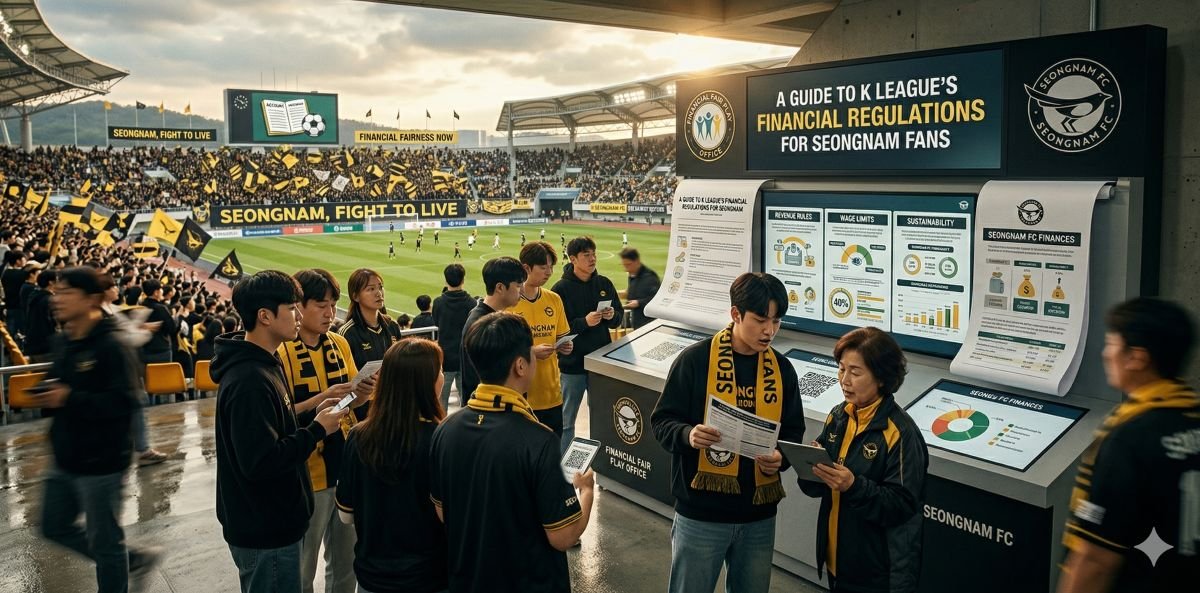
As the 2026 K League 2 season enters its decisive middle phase, the conversation among supporters of clubs like Seongnam FC and Suwon Samsung Bluewings often centers on roster depth and transfer activity. However, behind every high-profile signing and contract extension lies a complex web of governance known as the Financial Sustainability Regulations (FSR).
In an era where global football is frequently disrupted by the boom-and-bust cycles of purely commercial ownership, the K League has adopted a more cautious, architecturally sound model. These regulations are not merely administrative hurdles; they are the structural safeguards that ensure regional clubs remain permanent fixtures of their communities. For the sports-literate fan in Gyeonggi-do, understanding the K League’s fiduciary framework is essential to grasping how their club is being built for the next decade.
The Philosophy of the “Soft Cap” and Luxury Tax
Unlike the “Hard Cap” systems found in North American sports like the NFL, or the relatively loose “Financial Fair Play” (FFP) rules in Europe, the K League utilizes a “Soft Cap” mechanism. This system is designed to allow ambitious clubs to spend on talent while ensuring that such spending does not destabilize the league’s competitive equilibrium.
The league sets a wage threshold tied to a percentage of the collective average revenue of the member clubs. If a club’s total player salary expenditure exceeds this threshold, they are not barred from competing; instead, they are required to pay a “Luxury Tax.”
This tax serves a dual purpose:
Redistribution: The funds collected from high-spending clubs are redistributed among clubs that operate within their means, effectively subsidizing the “middle class” of the league.
Market Correction: It forces ownership to calculate the “true cost” of a star player. A 1 billion KRW salary might actually cost the club 1.2 billion KRW once the tax is applied, incentivizing a more rigorous approach to scouting and data-driven recruitment.
This regulatory approach is a regional manifestation of how global legal models and structural differences in governance shape the way entertainment and sports industries operate. By prioritizing sustainability over unchecked growth, the K League ensures that clubs don’t “over-leverage” their future for a single season of success.
Homegrown Incentives: The U-22 Rule as a Financial Tool
A cornerstone of the K League’s financial architecture is the Under-22 (U-22) Rule. While fans often view this through a tactical lens—requiring teams to start at least one U-22 player to unlock their full substitution quota—the rule is fundamentally a financial sustainability mechanism.
For a club like Seongnam FC, which boasts one of the most respected youth academies in the Gyeonggi-do region, this rule provides a direct financial advantage. By promoting “homegrown” talent into the first team, the club can manage its wage bill more effectively. Homegrown players typically command lower initial salaries compared to established veterans or international signings, yet they provide high-value output.
The K League further incentivizes this by offering roster-spot allowances and financial grants to clubs that exceed minimum requirements for youth integration. This creates a “virtuous cycle”:
Reduced Transfer Fees: Developing talent internally reduces the need for expensive domestic transfers.
Asset Appreciation: Successfully integrating a young player increases their market value, providing the club with a potential “transfer profit” in future windows.
This focus on internal development is deeply connected to the broader evolution of the club’s identity, as explored in our report on the color of governance and the Seongnam FC civic club shift. When a club is viewed as a public asset, its primary duty is to foster local talent rather than importing expensive, short-term solutions.
The Revenue-to-Expense Ratio: Engineering Long-Term Viability
The ultimate goal of the FSR is to prevent a “financial cliff.” The league monitors each club’s Revenue-to-Expense ($R:E$) Ratio to ensure that operational costs are supported by genuine income streams (sponsorships, broadcasting rights, and match-day revenue) rather than unsustainable debt.
In a healthy club model, the ratio is ideally:
If a club’s expenses consistently outpace its revenue, the league can mandate “Budget Corrective Actions.” These might include a freeze on new signings or a requirement for the parent company (or municipal government) to provide a “Stability Guarantee.”
This level of oversight is particularly critical for clubs in Gyeonggi-do, where the “derby” culture between Seongnam, Suwon, and Anyang creates immense pressure to win immediately. The FSR acts as a “speed governor,” ensuring that the local rivalry remains a healthy sporting competition rather than a financial arms race that could bankrupt a regional institution.
Why the Fan Should Care
For the entry-level fan, these rules might seem like “back-office” concerns. However, the FSR directly impacts the product on the pitch. It ensures that when you buy a season ticket for Seongnam FC, you are investing in a club that will still exist ten, twenty, or fifty years from now.
By prioritizing the “Homegrown” player and enforcing a “Luxury Tax,” the K League has created a system where survival is predicated on intelligence, scouting, and community integration rather than just the size of an owner’s bank account. This is the essence of modern sports literacy: recognizing that the most successful clubs are not always the ones that spend the most, but the ones that understand the architecture of the system they play in.