
How Football Simulation Models Work — What Korea’s 77% World Cup Probability Actually Means

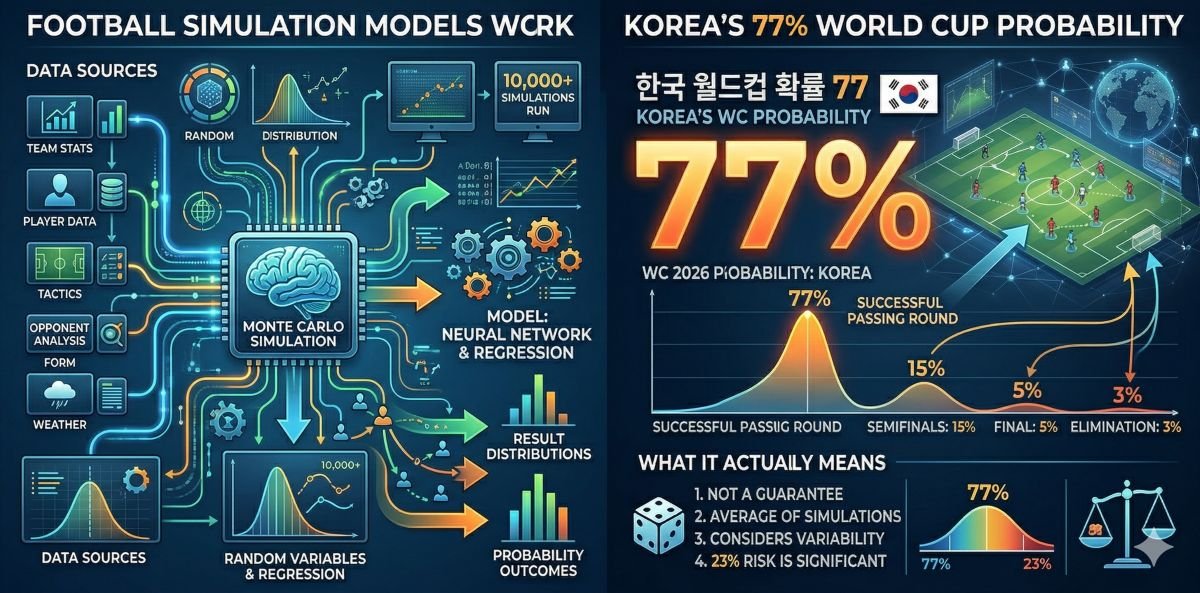
A figure of 77 percent sounds precise. It sounds like information. But understanding what a World Cup qualification probability actually represents — how it is generated, what assumptions sit behind it, and why two credible outlets can produce radically different assessments of the same team — is more analytically useful than the number itself.
Where the 77 Percent Comes From
Football Meets Data, a soccer statistics media outlet, released simulation results showing South Korea has a 77 percent chance of advancing from Group A at the 2026 FIFA World Cup. Mexico leads the group at 90.3 percent. The Czech Republic sits at 55 percent and South Africa at 23 percent. Korea’s expected average points total across the group stage is 4.5, with the most likely individual outcomes being one win and two draws for five points, or one win, one draw, and one loss for four points.
These figures did not emerge from expert judgment or a single calculation. They are the output of a simulation model run across thousands — often tens of thousands — of individual tournament iterations. Understanding that production process is the starting point for interpreting the result correctly.
How Football Simulation Models Actually Work
A football simulation model begins with team ratings. These ratings attempt to capture the overall quality of each team using historical match results, recent form, the strength of opponents faced, home and away performance records, and sometimes player-level data aggregated to the squad level. The rating system itself varies between providers — some use Elo-style systems that update continuously after each match, some use FIFA rankings as an input, some build proprietary models that blend multiple data sources.
Once team ratings are established, the model generates a match probability for each fixture in the tournament. Given Korea’s rating versus Czechia’s rating, the model estimates a probability distribution across three outcomes: a Korea win, a draw, or a Czechia win. These are not equal probability events — the ratings difference between the teams shifts the distribution.
The simulation then runs the tournament thousands of times. In each iteration, it uses those probability distributions to generate random outcomes within the defined probability space. So if Korea has a 45 percent chance of winning, a 30 percent chance of drawing, and a 25 percent chance of losing against Czechia, the simulation does not predict a Korea win — it generates a random outcome weighted toward those probabilities, then moves to the next match and does the same.
After running 10,000 or 100,000 iterations, the model counts the proportion of simulations in which Korea accumulated enough points to advance from Group A. That proportion is the 77 percent figure. It does not mean Korea is likely to advance. It means that in 77 out of every 100 simulated versions of this group stage, Korea accumulated sufficient points to go through.
What 77 Percent Does Not Mean
The most common misreading of probability outputs is treating them as predictions. A 77 percent advancement probability does not mean Korea will advance. It means that under the model’s assumptions, the scenarios in which Korea advances are substantially more common than the scenarios in which they do not. But the 23 percent of simulations in which Korea fails to advance are still happening — and in any individual real-world tournament, only one outcome occurs.
Put differently: if you ran the 2026 World Cup Group A stage 100 times with these teams at these rating levels, Korea would advance in approximately 77 of them. But this tournament is run once. The 77 percent is a statement about a distribution of possible outcomes, not a forecast of the specific outcome that will materialize.
This distinction matters practically for Korean fans assessing the team’s prospects. A 77 percent probability is meaningfully better than even odds — it indicates genuine structural advantage. But it coexists with a 23 percent probability of group stage elimination, and nothing in the simulation guarantees which scenario applies to June 2026.
Why The Athletic and The Guardian Disagree So Sharply
The most revealing illustration of simulation model limitations comes from the divergence in how different credible outlets have assessed South Korea ahead of the tournament. The Athletic ranked Korea 16th out of 48 World Cup teams, predicting advancement to the round of 32 and suggesting a realistic path to the round of 16. The Guardian ranked Korea 44th — near the bottom of the entire field — citing recent performances including a 0-4 loss to Ivory Coast and a 0-1 defeat to Austria, and raising concerns about tactical vulnerabilities under coach Hong Myung-bo.
Both outlets are credible. Both are working from publicly available information about the same team. The gap between 16th and 44th is not explained by one outlet being right and the other being wrong. It is explained by a more fundamental issue: the inputs determine the outputs.
A model that heavily weights historical track record — Korea’s eleven consecutive World Cup qualifications, their semifinal finish in 2002, their round of 16 appearances in 2010 and 2022 — will produce a substantially higher rating than a model that heavily weights recent form. A team with Korea’s history but recent warm-up match losses looks very different depending on how far back the evaluation window extends and how much it discounts or emphasizes recent results.
Neither weighting choice is objectively correct. They reflect analytical assumptions about what information is most predictive of future tournament performance. A historically grounded model argues that recent form in March friendly matches is a poor predictor of June World Cup performance. A recency-weighted model argues that the current tactical and physical state of the team matters more than what they achieved years ago. Both positions have legitimate analytical basis.
How Korea’s Tactical Profile Creates Model Complexity
South Korea’s playing style introduces additional complexity into how simulation models capture team quality. Korea under Hong Myung-bo plays a high-energy, pressing-oriented game built around organized defensive shape and rapid transitions through Son Heung-min’s pace and directness. This profile is effective against certain opposition types and potentially vulnerable against others.
Simulation models that use aggregate team ratings do not necessarily capture this stylistic dimension. A model might rate Korea as a 22nd-ranked team globally without encoding anything about how their high press interacts with technically proficient possession teams, or how their counter-attacking threat changes the calculus against defensively deeper opposition.
Korea’s opponents in Group A — Mexico, Czechia, and South Africa — have notably different stylistic profiles. Mexico’s possession-oriented play, Czechia’s disciplined European structure, and South Africa’s physical directness each interact with Korea’s tactical identity in ways that aggregate ratings cannot fully model. Whether that creates upside or downside for Korea depends on assessments that simulation models can only partially incorporate.
Reading Probability Outputs as a Calibrated Fan
The practical skill that makes all other football analytics more useful is learning to read probability outputs as model-dependent distributions rather than as predictions. When you see a 77 percent figure, the analytically useful response is to ask three questions: What inputs drove this number? How does this provider weight historical versus recent performance? What would change about the output if those assumptions shifted?
Comparing outputs across multiple models — the Football Meets Data simulation, The Athletic’s power ranking, The Guardian’s assessment — and understanding why they differ tells you more about Korea’s genuine uncertainty than any single figure can. A team that ranks 16th in one credible model and 44th in another is a team with genuinely contested prospects, where the outcome depends substantially on which version of Korea shows up in North America this summer.
For deeper analytical context on why even strong teams produce surprising results and how probability and variance interact in competitive sport, 분산과 변동성 데이터의 흔들림을 이겨내는 법 provides directly relevant framing on navigating statistical noise in sports analysis. For a Seongnam-focused look at how these analytical concepts apply to evaluating football performance at the club level, 2026 K League 2 Promotion and Relegation: A Guide for Seongnam FC Fans demonstrates how probabilistic thinking applies to domestic Korean football contexts.
The 77 percent probability for Korea is a useful piece of information. It is not a promise, not a forecast, and not a substitute for understanding what it means to be a team with genuine advancement probability playing in a group where elimination is far from impossible.