
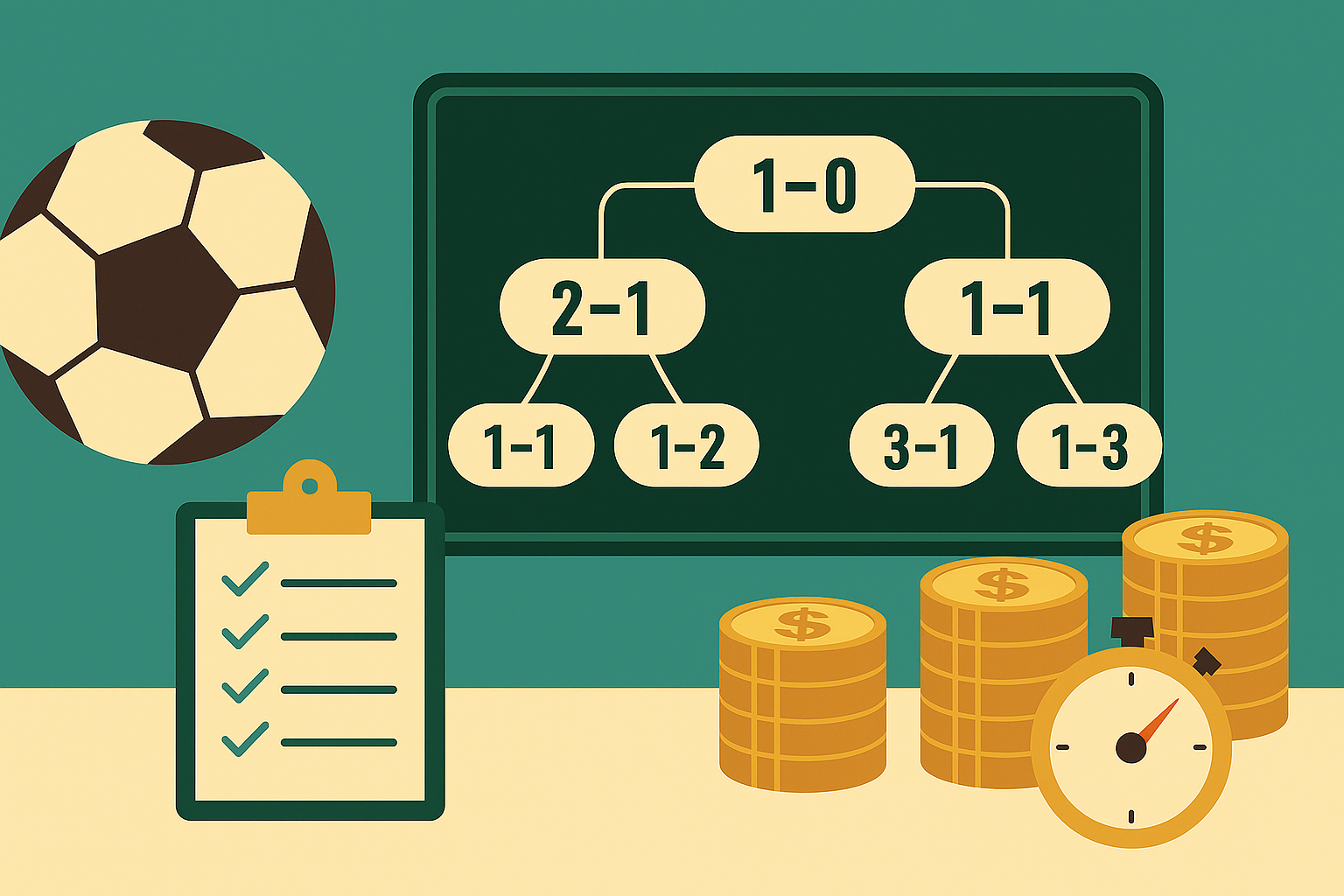
Most sports wagering markets reduce a match to a manageable set of outcomes. A standard 1X2 market — home win, draw, or away win — gives a participant three possibilities to evaluate. The analysis is relatively contained: assess the relative strength of the two sides, factor in home advantage and recent form, and arrive at a judgment about which of the three outcomes is most likely.
HT/FT betting — halftime/fulltime — operates on a fundamentally different structural logic. Understanding why HT/FT bets multiply possible outcomes is essential before engaging with this market, because the combinatorial expansion of outcomes is not just a feature of the format — it is the primary reason why both the potential returns and the difficulty of winning are substantially higher than in single-result markets.
The Combinatorial Structure
The mathematical structure of HT/FT betting is straightforward but important to grasp clearly. A standard football match has three possible results at any point: home win, draw, or away win. At halftime, there are three possible results. At fulltime, there are three possible results. When these two independent events are combined into a single prediction, the number of possible outcomes is not the sum of the two sets — it is their product.
Three halftime outcomes multiplied by three fulltime outcomes produces nine possible combinations. These are: home/home, home/draw, home/away, draw/home, draw/draw, draw/away, away/home, away/draw, and away/away. The first element in each pair represents the halftime result; the second represents the fulltime result.
This nine-outcome structure is what defines HT/FT betting. A participant is not choosing between three possibilities — they are choosing between nine. And because each of those nine combinations requires both components to be correct simultaneously, the probability of any given prediction being right is substantially lower than a standard match prediction, even when the individual components appear straightforward.
Why Some Combinations Are Structurally Rare
Not all nine outcomes are equally probable, and understanding the distribution matters for any serious analysis of this market. Some combinations are structurally common; others are structurally rare. The frequency of each reflects the underlying dynamics of how football matches unfold.
Home/home — the home team leads at halftime and wins at fulltime — is the most frequent combination in matches where the home side is the clear favorite, precisely because home teams that establish early leads tend to control the second half. Away/away follows a similar logic for matches dominated by the away side. Draw/draw occurs in closely matched contests where neither side creates a decisive advantage in either half.
The combinations that attract the highest odds are those that require a momentum reversal — a situation where the halftime result is overturned by fulltime. Away/home (away team leads at halftime, home team wins at fulltime), home/away, draw/away, and draw/home all require specific dynamics: an early lead surrendered, a second-half comeback, or a tactical shift that changes the course of the match. These outcomes happen, but they are the exception rather than the rule in most competitive contexts. Their rarity is precisely what generates their high odds — and precisely what makes them the most difficult to predict reliably.
The Odds Multiplication Effect
The relationship between the combinatorial structure and the odds is direct and mathematically precise. As explored in analyses of how HT/FT odds structure reflects the relationship between high odds and high risk, the odds attached to any HT/FT combination are not simply the odds of the fulltime result — they are a reflection of the joint probability of both the halftime and fulltime components occurring together.
When a strong home favorite has a fulltime win probability of roughly 60%, and a halftime lead probability of roughly 55%, the joint probability of both occurring — home/home — is approximately the product of these probabilities, adjusted for their correlation. The result is a combined probability that is lower than either component alone, which is reflected in odds that are higher than a simple home win but lower than the reversal combinations. The market pricing of HT/FT outcomes is, in this sense, an exercise in conditional probability: the odds of the fulltime outcome given the halftime outcome is established.
What This Means for Analysis
The nine-outcome structure of HT/FT betting has a specific implication for how analysis should be approached. A participant evaluating a standard 1X2 market needs to assess one question: what is the most likely overall result? A participant evaluating an HT/FT market needs to assess two questions simultaneously: what is the most likely halftime result, and given that result, what is the most likely fulltime outcome?
These are meaningfully different analytical tasks. The halftime result is influenced by factors that do not necessarily predict the fulltime result — the tactical approach of a team in the opening period, which may differ from their second-half setup; the pace at which a game begins; the specific personnel deployed in each half. A team that regularly starts conservatively and builds into matches may have a halftime profile that looks very different from its fulltime profile, even against the same opposition.
Understanding this divergence — between a team’s typical halftime and fulltime patterns — is the analytical edge that makes HT/FT analysis more than a dressed-up version of standard match prediction. The structure multiplies outcomes; the analysis has to match that complexity.
The Role of Bookmaker Margin
One dimension of HT/FT betting that receives less attention than it deserves is the bookmaker margin across nine outcomes rather than three. In a standard 1X2 market, the bookmaker’s margin is distributed across three possibilities. In an HT/FT market, that margin is distributed across nine. The result, in most cases, is that the HT/FT market carries a higher effective margin than the standard match market — meaning the built-in house advantage is larger relative to the odds offered.
This is not a reason to avoid the market, but it is a structural feature that informed participants account for. The attractive-looking odds on a reversal combination — the kind that would pay 15 or 20 times the stake — are not pure reflections of the combination’s rarity. They embed the bookmaker’s margin in addition to the underlying probability, which means the gap between the displayed odds and the fair odds is typically larger in HT/FT markets than in simpler markets.
Final Thoughts
HT/FT betting multiplies possible outcomes because it combines two independent predictions into a single simultaneous requirement. The resulting nine-combination structure is the source of both its appeal — higher odds, larger potential returns — and its difficulty. Neither dimension should be engaged with in isolation from the other. The higher odds exist because the correct prediction is genuinely harder to achieve, not because the market is systematically mispriced in the participant’s favor.
Engaging with the HT/FT market productively means understanding the full combinatorial structure, analyzing halftime and fulltime patterns separately and in relation to each other, and accounting for the margin embedded in the pricing. That is a more demanding analytical process than standard match prediction — which is exactly what the structure requires.
Nine outcomes means nine questions. Getting one right is not enough.