
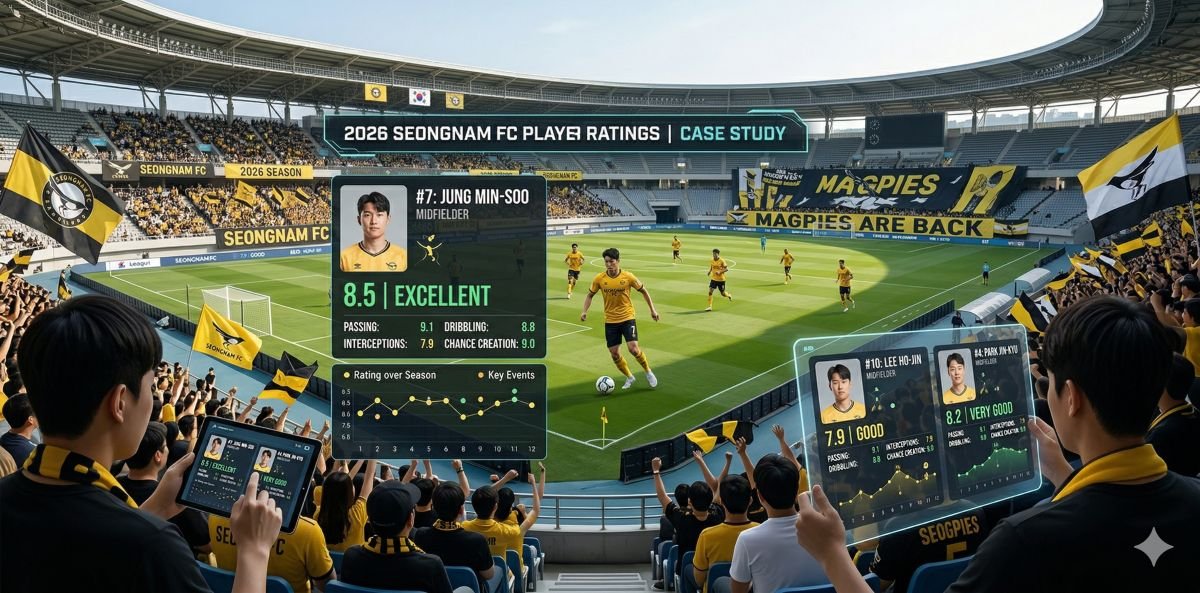
The opening rounds of the 2026 K League 2 season have provided a fascinating statistical puzzle for Seongnam FC supporters. After two matches, the club sits on two draws, having both scored and conceded three goals. While the league table suggests a stalemate, the algorithmic player ratings tell a more nuanced story of individual excellence. Brazilian midfielder Elionay currently leads the squad with a standout rating of 7.22, followed closely by Jue-An Yoo at 7.13 and Seung-Yong Jung at 7.08.
For the average fan checking their phone at Tancheon Sports Complex, these numbers are a shorthand for “who played well.” However, the methodology behind these decimals is rarely explained. By using Seongnam’s early 2026 data as a grounded case study, we can deconstruct how these ratings are built, what they prioritize, and where they might miss the mark.
The Foundation: Event-Based Data Collection
Modern player ratings are not the result of a human scout sitting in the stands with a clipboard. Instead, they are generated by algorithms that ingest thousands of data points per match. Every touch of the ball is categorized as an “event.” When Elionay makes a pass, the system doesn’t just record a successful completion; it notes the coordinates of the pass, the distance, the direction, and the pressure from the opponent.
These events are assigned a base value. A forward pass into the final third is worth more than a sideways pass in the defensive half. For a midfielder like Elionay, a high rating of 7.22 suggests he is not just retaining possession, but consistently performing “high-value” actions that progress the ball into dangerous areas. The algorithm rewards the technical difficulty and the strategic intent of his play, which explains why his rating remains high even when the team as a whole settles for a draw.
The Weight of Outcomes: Goals, Assists, and Errors
While the “volume” of actions provides the baseline, specific outcomes act as massive multipliers. Goals and assists are the most significant boosters in any rating system. If Jue-An Yoo scores a late equalizer, his rating might jump from a 6.5 to a 7.5 instantly. This is because algorithms are designed to mirror the impact of the match.
Conversely, “negative events” act as heavy anchors. A defensive error leading to a goal, a red card, or a missed “big chance” will cause a player’s rating to plummet. In Seongnam’s opening matches, conceding three goals likely suppressed the ratings of the defensive line, even if their individual positioning was generally sound. Algorithms struggle with “off-the-ball” contributions, such as a defender who prevents a pass by simply standing in the right lane. Because no “event” occurred, the system has nothing to reward.
Why Ratings Differ Across Platforms
Fans often notice that a player might be a 7.2 on one app and a 6.8 on another. This happens because different platforms use different weighting for their variables. Some systems, like those used by professional clubs for recruitment, might prioritize “Expected Goals” (xG) or “Expected Assists” (xA). Others might give more weight to defensive actions like interceptions and successful tackles.
For instance, Seung-Yong Jung’s 7.08 rating suggests a balanced contribution. On a platform that favors defensive stability, he might be the highest-rated player. On a platform that over-indexes on offensive creativity, he might slip behind the attackers. This discrepancy is why it is essential to view these numbers as a single perspective rather than an absolute truth. You can see how 축구 기대 득점(xG)과 기대 도움(xA)의 힘 provides the mathematical backbone for these different interpretations.
The Limits of the Algorithm
The greatest weakness of any player rating system is its inability to account for tactical instructions. If a Seongnam coach instructs a winger to stay wide and stretch the defense without touching the ball, that player is technically performing his job perfectly. However, the algorithm will see a player with very few touches and likely hand them a low 6.0 rating.
Furthermore, these systems often fail to capture the “emotional” or “leadership” value of a player. A captain who organizes the defense during a frantic final five minutes provides immense value that isn’t captured in a tackle count. This is why a 7.22 rating for Elionay is an indicator of high technical output, but it doesn’t tell us if he was the vocal leader on the pitch.
Understanding these limits helps fans avoid the trap of “stat-watching.” While numbers provide a clear framework, they are often a reaction to what happened, not a prediction of what will happen next. This is a common hurdle in sports analysis, where the limits of probability in single-event outcomes remind us that a high player rating doesn’t guarantee a win in the next match.
Conclusion: Context is King
Player ratings are a powerful tool for comparing performance across a long season, but they require context to be useful. Elionay’s 7.22 is a signal of elite technical consistency in the K League 2, but it must be viewed alongside the team’s three goals conceded.
As the 2026 season progresses, these ratings will fluctuate. A player who starts with a string of 8.0 performances might regress as opponents adapt to their style. For Seongnam FC followers, the key is to use these numbers as a starting point for conversation, not the final word on a player’s worth. The algorithm sees the touches, but the fans see the effort, the grit, and the local pride that a number can never fully quantify.