
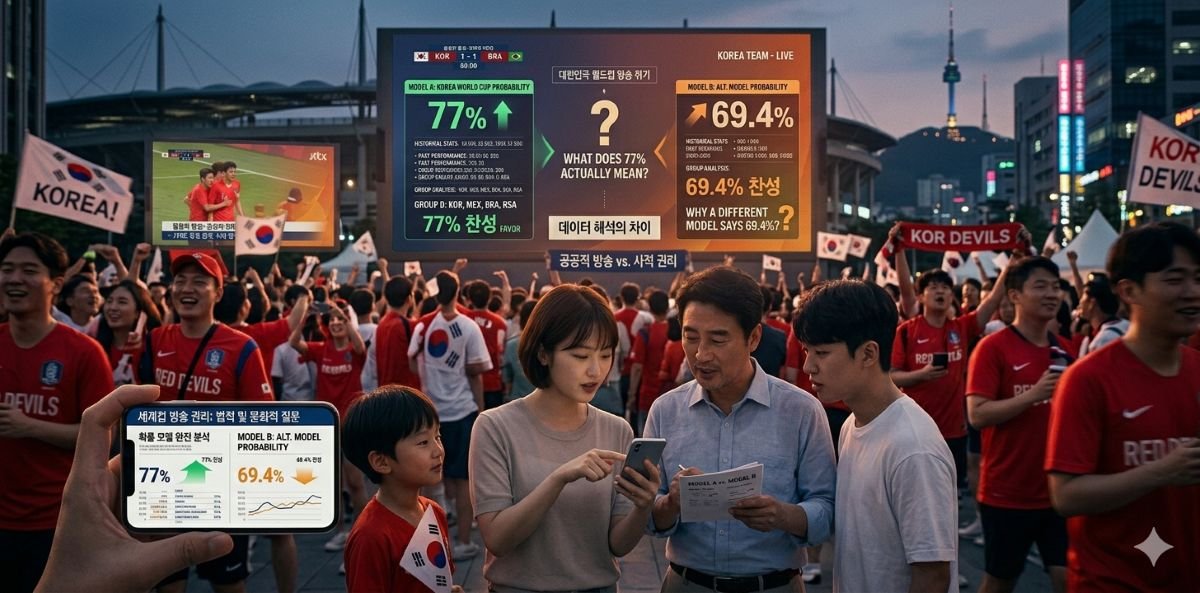
Two independent analytics outlets published probability estimates for South Korea’s 2026 World Cup group stage passage within the same week in early April, and they disagreed by 7.6 percentage points. Football Meets Data placed Korea’s advancement probability at 77%. Football Benchmark, using a methodology grounded in European market data, put the figure at 69.4%. Both are credible sources. Neither is wrong in any simple sense. And the gap between them tells you more about how football simulation models work than any single figure alone could.
Understanding why those numbers differ — and what each is actually measuring — is useful for any sports fan who wants to interpret probability figures critically rather than simply accepting them as fact.
What a Simulation Model Is Doing
A football simulation model is not a prediction. It is a probability-weighted forecast generated by running a match scenario many thousands of times, using historical data to assign each team a rating and then computing how often different outcomes occur across all those simulated runs.
The core inputs vary by model. A squad-based model assigns ratings to individual players, weights those ratings by expected minutes played, and uses the resulting team strength estimate to determine match probabilities. A market-based model derives implied team strength from how professional traders have priced the outcomes in liquid betting markets, treating that collective judgment as a more efficient signal than any individual analyst’s assessment.
Football Meets Data used a squad-based approach. For Korea’s 4.5 expected group stage points and 77% advancement figure, the model is reflecting the quality of players like Kim Min-jae (Bayern Munich), Son Heung-min (LAFC), and Lee Kang-in (PSG) relative to Czech Republic’s squad, which contains fewer players at that level of club competition.
Football Benchmark, using European market data, reached 69.4% — placing Korea third in Group A behind both Mexico (90.1%) and Czech Republic (80%). This ranking inverts the FIFA ranking order: Korea sits 25th globally, Czech Republic 41st. Yet Football Benchmark’s market-informed model rates Czech Republic as more likely to advance. The reason, which the analysts explicitly noted, is recent A-match performance. Korea lost 0-4 to Ivory Coast and 0-1 to Austria in March 2026 warmup matches. Czech Republic, meanwhile, demonstrated resilience and set-piece precision across two consecutive penalty shootout wins to qualify. Markets priced that recent evidence more heavily than squad depth.
Neither model is wrong. They are weighting different kinds of evidence.
Why the 48-Team Format Changes the Calculation
One structural element that makes Korea’s probability higher than it would be under previous formats is the expanded tournament structure. The 2026 World Cup includes 48 teams in 12 groups of four, with the top two from each group advancing automatically. Crucially, the eight best third-placed teams across all 12 groups also advance to the Round of 32.
Football Meets Data’s simulation found that Korea’s most likely group outcome is second place (30.8%), followed by winning the group outright (27.1%), finishing third (25.6%), and elimination in fourth (16.4%). With an expected points total of 4.5 — corresponding to a combination of one win and two draws or similar outcomes — Korea could finish third and still qualify if that points total compares favorably with other third-placed finishers from other groups.
This is a genuine format-driven shift. In the previous 32-team structure, finishing third would typically mean elimination. In 2026, it creates a genuine secondary qualification pathway, which raises every team’s overall advancement probability compared to equivalent historical tournaments. Any simulation model that properly accounts for this format will produce higher figures for teams in Korea’s position than older comparison data would suggest.
What the Numbers Do Not Tell You
Probability figures from simulation models are forward-looking estimates with known limitations that are worth naming explicitly. They assume that past performance is a reliable guide to future outcomes. They do not account for in-tournament factors: injuries during the group stage, weather, altitude in Mexico City, or the psychological dynamics of a squad playing in what may be Son Heung-min’s final World Cup appearance.
More specifically, a squad-based model can overestimate team strength if players are not playing regularly at club level. A market-based model can be distorted by public sentiment, particularly for teams with large supporter communities whose fans may skew betting markets toward optimism.
As examined in how football simulation models are built and applied at the analytics level, the gap between two credible models is itself the most informative signal — not the specific figures. When Football Meets Data produces 77% and Football Benchmark produces 69.4%, the honest interpretation is that Korea’s true probability lies somewhere in that range, and that the uncertainty between those endpoints reflects genuine analytical disagreement about how to weight recent poor form against structural squad quality.
Why Seongnam’s Football History Provides Useful Context
Seongnam FC’s analytical legacy is worth noting here. The club spent much of its peak era under Ilhwa ownership producing not just results but systematically superior squad construction — seven K League 1 titles and two AFC Champions League victories through an approach that was, for its era, among the most analytically grounded in Korean football. The city has a reasonable claim to being one of the more analytically literate environments for football discussion in Gyeonggi-do.
That context matters when reading probability figures about the national team. A 77% figure is not a promise. A 69.4% figure is not a pessimistic outlier. Both are estimates produced by models with different methodological assumptions, and the most useful response to both is the same: understand what each is measuring, recognize the range of uncertainty they collectively describe, and follow the tournament itself as the one simulation that actually counts.
Korea’s group stage matches begin in June. The models will have been right or wrong by July. In the meantime, the gap between those two numbers is the honest answer.
Read also: gwangjuinsider.com/접전은-정확성을-증명하지-않는다/