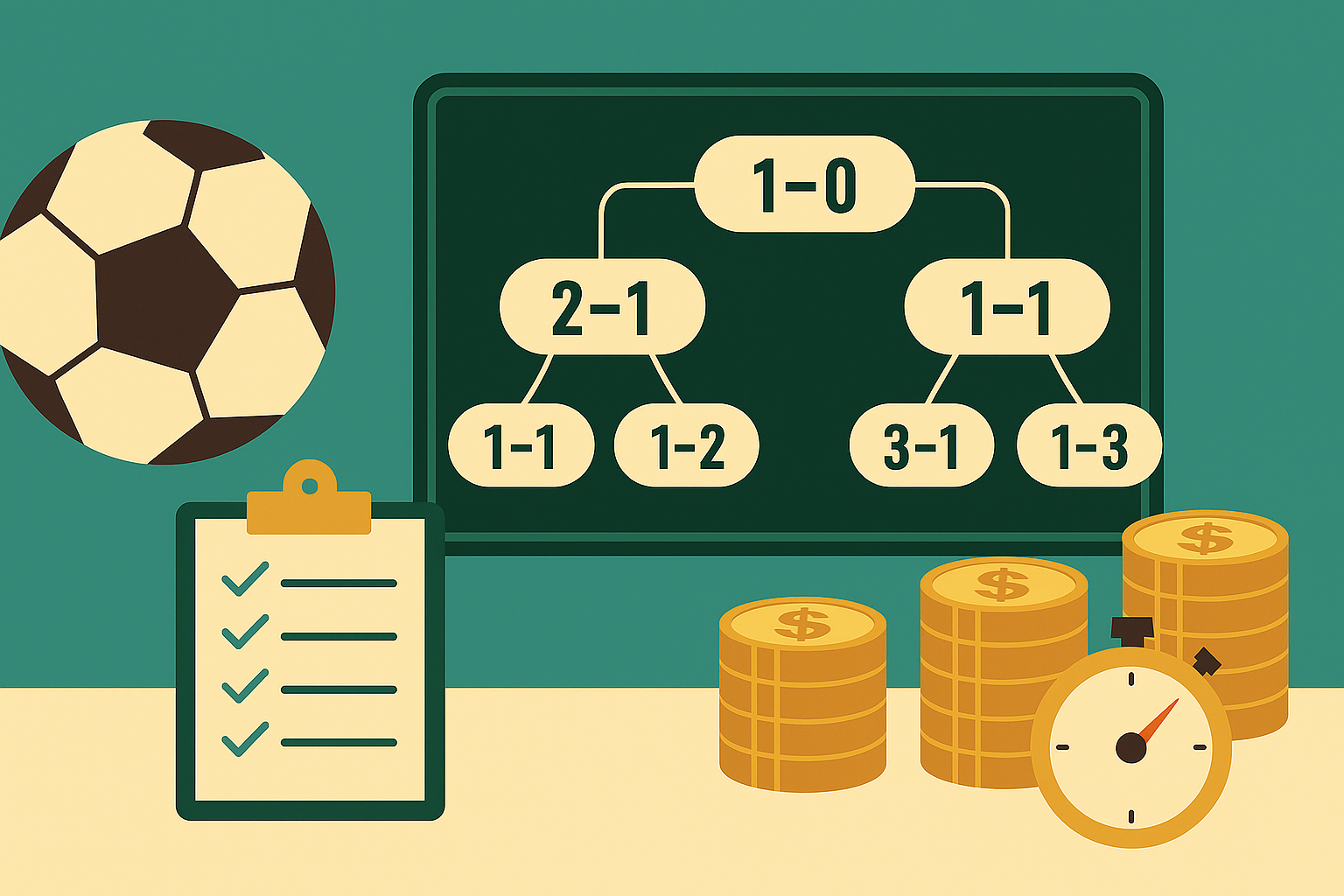


Repeated decisions feel random because of a concept called variance, which is the natural “swing” of results that happens in the short term. Even if a choice has a high chance of success, it can still fail several times in a row. This gap between what we expect to happen on average and what actually happens in one specific moment makes us feel like we are just lucky or unlucky. However, if the decision is based on sound logic, the math will eventually win over a long period, even if it feels chaotic in the present.
The Game of Expected Value
To understand why life feels so random, we have to look at “expected value.” This is a math term that describes the average result of an action if you were to repeat it many times. For example, if you play a game where you have a 60% chance to win $10 and a 40% chance to lose $5, the math says you should play that game every single time. On average, you will make money.
The problem is that you do not live in the “average.” You live in the “now.” When you play that game the first time and lose $5, it feels like a bad choice. If you lose three times in a row, you might think the game is broken or that you have bad luck. This is the difference between the long-term expectation and the short-term reality.
Why Variance Hides the Truth
Variance is the “noise” or the “spread” that happens around the average. If the average result is a win, variance is the reason you still experience losses. You can find more about how this works by checking the definition of variance.
Imagine a professional basketball player who makes 90% of his free throws. We expect him to make almost every shot. However, variance says that every once in a while, he will miss three in a row. For a fan watching that one game, the player looks like he is having a bad day. For a statistician looking at 1,000 games, the player is exactly who they thought he was.
The randomness we feel is usually just variance playing out. Because humans have short memories and focus on what happened today, we struggle to see the steady line of expectation underneath all the noise.
Expert Advice on Luck and Logic
Experts who study how people make choices often warn us about focusing too much on a single result. Annie Duke, a researcher and former poker champion, calls this “resulting.” She says that “decisions are bets on the future, and they aren’t ‘right’ or ‘wrong’ based on whether they turn out well on any particular iteration.”
In her book, Thinking in Bets, Duke explains that a good decision can lead to a bad outcome, and a bad decision can lead to a good outcome. If you drive through a red light and get home safely, it was still a bad decision. If you drive through a green light and get into an accident, it was still a good decision. The “randomness” of the accident does not change the fact that following the law is the better long-term choice.
Daniel Kahneman, a famous psychologist, also notes that “a single success is not proof of a good strategy, and a single failure is not proof of a bad one.” He argues that humans are hard-wired to look for patterns, so when we see a few bad results, we invent a reason for them rather than accepting that it is just variance.
The Data of Big Numbers
To see how much trials matter, we can look at a simulation of a simple coin flip. A coin has a 50% “expected value” for heads. But if we only flip it a few times, the results look very random.
| Number of Flips | Result of Heads | Distance from 50% |
| 10 | 70% | 20% |
| 100 | 54% | 4% |
| 1,000 | 50.8% | 0.8% |
| 10,000 | 50.1% | 0.1% |
This data shows that as we do something more often, the “randomness” starts to disappear. At 10 flips, the result is 20% away from the truth. At 1,000 flips, it is less than 1% away. This is known as the Law of Large Numbers. It tells us that the more times we make a good decision, the less likely it is that “bad luck” will ruin us. The feeling of randomness is only strong when we are looking at a small number of events.
How to Focus on the Process
If you want to stop feeling like your life is a series of random accidents, you have to change how you judge yourself. Instead of looking at the result of your last choice, look at the process you used to make it.
Count your attempts: If you are trying a new sales technique or a new habit, do not judge it after three tries. Give it 50 or 100 tries before you decide if it works.
Write down your reasons: Before you make a big choice, write down why you think it is a good idea. If it fails but your reasons were solid, you made a good choice that just hit a “variance” bump.
Ignore the “noise”: Daily ups and downs in the stock market or your fitness progress are often just variance. Look at the weekly or monthly trend instead.
By understanding that variance is a natural part of every system, you can stay calm when things go wrong. You can trust that if your “expected value” is positive, the math will eventually catch up to your efforts. Randomness is just a shadow that disappears when you shine the light of enough repetitions on it.