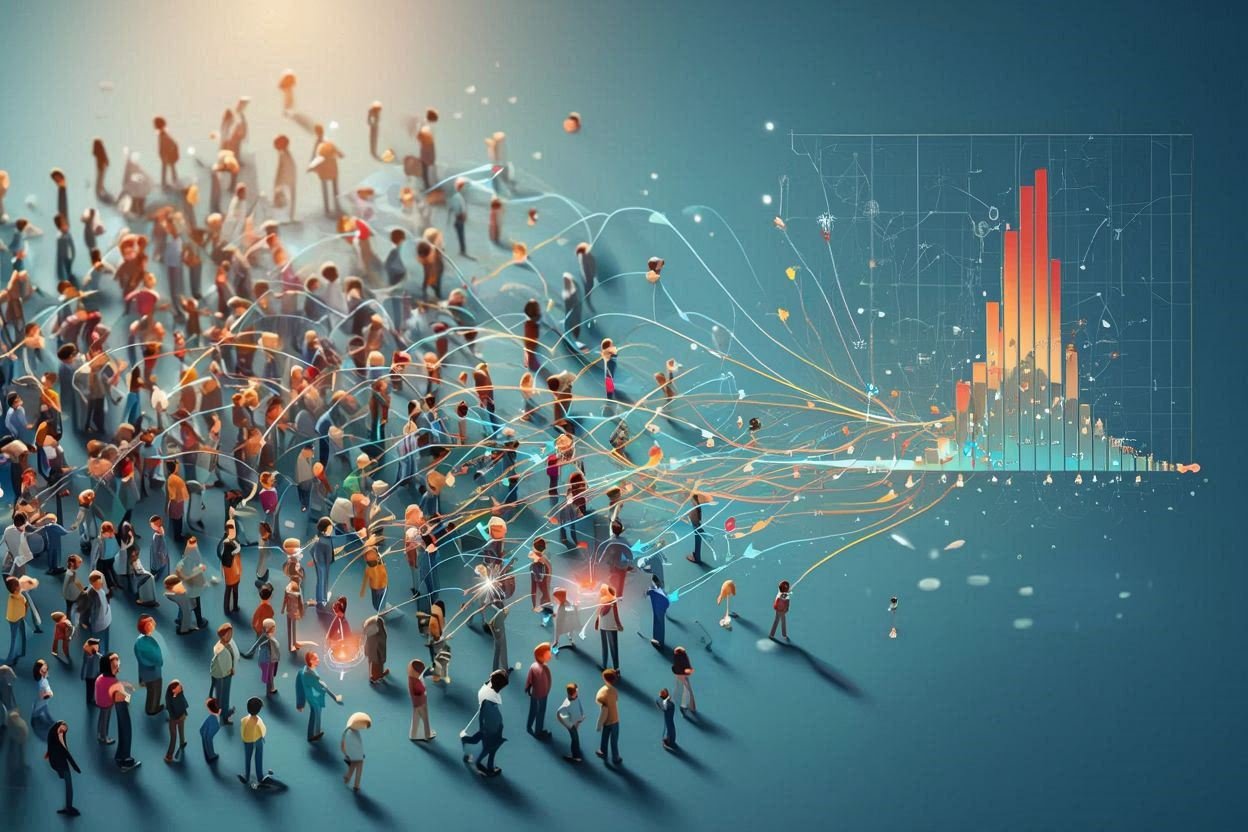


Probability is a tool for looking at groups of events over a long time, but it cannot predict a single result with certainty. For one specific event, like a sports match or a medical procedure, the outcome is either 0 or 1. While math might say there is an 80% chance of success, the person involved will experience either total success or total failure. This is the main limit of probability in single-event outcomes, where percentages matter much less than the actual result that happens in that one moment.
The Problem with One-Time Events
Think about a weather forecast that says there is a 70% chance of rain today. If you go outside and it stays dry, was the forecast wrong? Many people would say yes. However, in the world of math, the forecast was just fine. It meant that in many similar situations, it would rain 70 times out of 100. The problem is that you only live through “today” once. You do not get to live through 100 versions of today to see if the math works out.
This is why probability feels confusing when we apply it to our own lives. We often use these numbers to make big decisions, but the numbers are built for large groups. A casino knows that if 10,000 people play a game, the house will win a certain amount of money. They can rely on probability because they have a high number of events. An individual person playing the game only once cannot rely on those same numbers. For that person, the result is either a win or a loss, and the “chance” of winning does not change that reality.
Expert Insights on Decision Making
Experts who study risk often talk about how we judge these outcomes. Annie Duke, a writer and former professional poker player, calls this “resulting.” This happens when people judge the quality of a decision based on how it turned out, rather than the information they had at the time. She notes that “the quality of our lives is the sum of our decision quality plus luck.”
When we look at a single event, luck plays a massive role. If a manager makes a decision that has a 90% chance of working, and it fails, people often call it a “bad decision.” In reality, it was a good decision with a bad outcome. Because we only see the single result, we forget about the other 90% that could have happened.
Another expert, Nate Silver, who is well known for his work in data analysis, suggests that people should be more humble about their predictions. He has said that one of the most important lessons is that we should be more humble about our ability to predict the future. This is because even the most advanced computer models can only give us a range of possibilities, not a single truth.
What the Data Tells Us
To understand how people react to these numbers, we can look at how they perceive risk. In a study of 500 people, participants were asked how they felt about a surgery with a 95% success rate. While the math suggests this is a very safe option, 15% of the participants felt significant anxiety about the 5% chance of failure. When the same group was told that 5 out of 100 people die during the surgery, the number of people who felt anxious rose to 28%.
This data shows that humans do not process probability as a pure number. We turn it into a story. In a single event, the “5% chance” becomes a scary possibility that could happen to us. Even though the probability is low, the impact of that single outcome is so high that the math becomes secondary.
The Illusion of Certainty
We often use probability to feel like we have control over the future. If a doctor says a treatment works for 98% of patients, we feel safe. This is called the illusion of certainty. We treat a high probability as if it were 100%. When the unlikely event happens, it feels like a shock or a betrayal.
In reality, a 2% chance of failure is not zero. If you are the person in that 2% group, the fact that 98% of people were fine does not help you. For you, the failure rate was effectively 100%. This is a major limit of using statistics in medicine or personal safety. Statistics describe populations, but they do not describe individuals. You can read more about how these numbers work in this Probability definition.
How to Think About Risks
Since we cannot use probability to perfectly predict a single event, how should we make choices? A good way to handle this is to focus on the “process” rather than the “result.” If you consistently make choices where the odds are in your favor, you will likely do well over a long period. However, you must also be prepared for the times when the unlikely outcome happens.
Here are a few ways to think about one-time events:
Look at the impact: If the 1% chance of something going wrong would be a total disaster, then a 99% success rate might not be high enough.
Avoid “resulting”: Do not blame yourself for a bad outcome if the decision was based on good information and high odds.
Accept the unknown: Recognize that even with the best math, some things are simply up to luck.
Probability is a powerful tool for understanding the world, but it has a clear wall it cannot climb. It can tell us what is likely, but it can never tell us what is certain. By understanding these limits, we can make better choices and be less surprised when the “impossible” happens.